Interiors · 2001 · Realized
A3 Showroom
The debut installation of Asymptote's A3 furniture system at Knoll's NeoCon showroom in Chicago's Merchandise Mart, a gallery-scaled exhibition environment that presented the 'anti-cube' workstation as both a product launch and a spatial manifesto for the future of work.
About the project
NeoCon and the Merchandise Mart
NeoCon, held annually at Chicago’s Merchandise Mart, is the commercial design industry’s most important venue for launching new products. For the debut of the A3 furniture system, Asymptote’s radical rethinking of the office workstation developed in collaboration with Knoll International, the presentation demanded more than a conventional showroom arrangement. Knoll commissioned Asymptote to design the installation itself, recognizing that the A3’s ambitions extended well beyond furniture into questions of spatial experience, working culture, and architectural identity. The result was a showroom that functioned simultaneously as product launch, brand statement, and exhibition, a space that performed the ideas embedded in the furniture it contained.
The Anti-Cube on Display
The A3, shorthand for “anti-cube”, had been conceived as a wholesale rejection of the rectilinear cubicle that had defined office interiors since Robert Propst’s Action Office of the 1960s. Its curvilinear, tent-like enclosures with translucent screens stretched across elliptical steel frames needed a presentation environment that would make this departure immediately legible. The NeoCon installation staged the workstations not as furniture on a trade-show floor but as sculptural objects in a gallery, isolated on expanses of white, lit from above, and given the spatial breathing room normally reserved for exhibited artworks. Visitors encountered the pods as they might encounter a sculpture in a museum: walking around them, approaching and retreating, registering their organic silhouettes against the clinical white datum of the showroom.
Typographic Wall and Media Integration
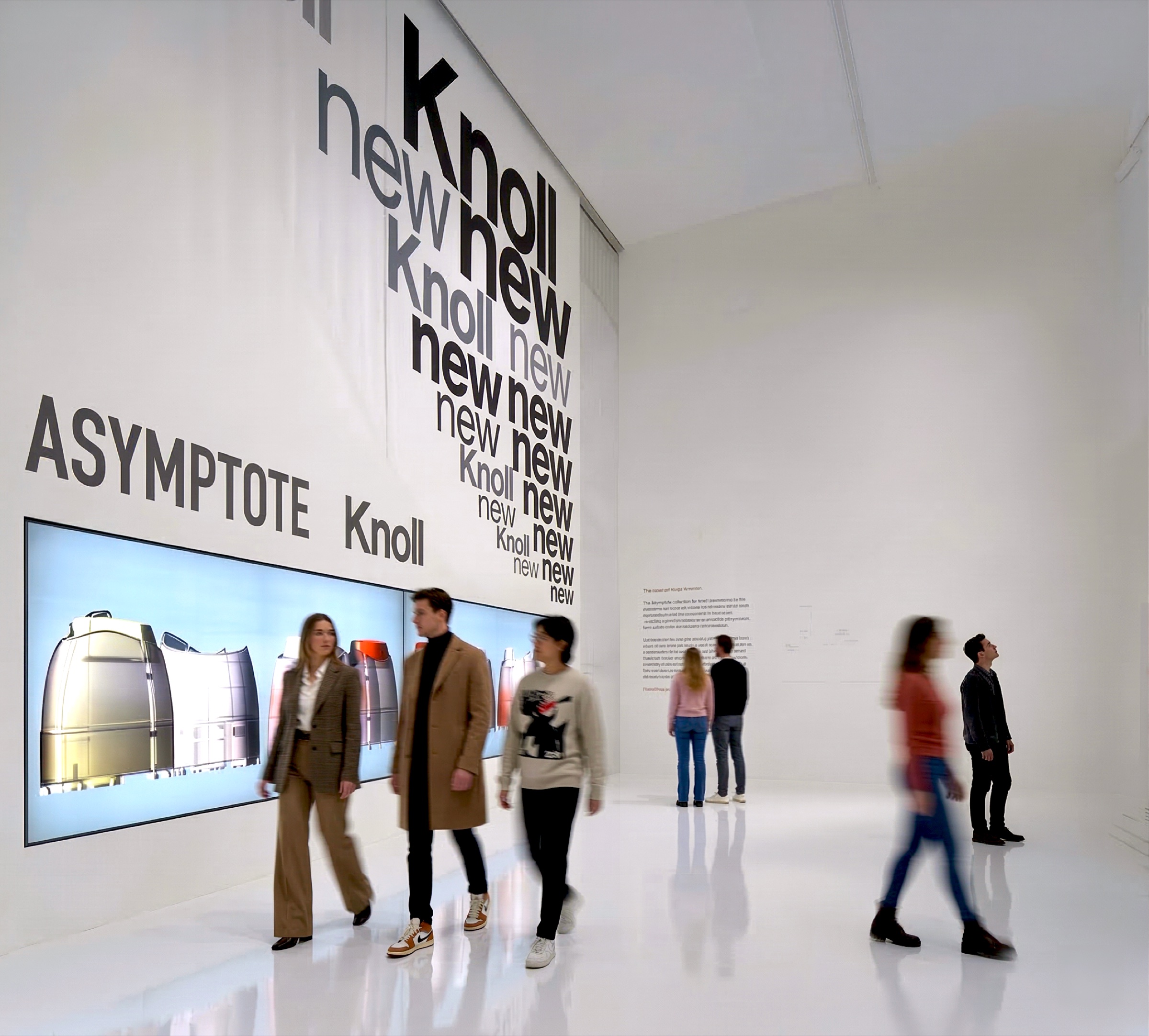
The entrance sequence announced the collaboration at architectural scale. A double-height wall carried the words ASYMPTOTE and Knoll alongside a cascading field of typographic repetitions, “knoll new new new”, rendered at varying scales and weights, producing a visual rhythm that echoed the A3’s own departure from orthogonal order. Embedded within this graphic surface, a large backlit screen displayed the workstation in its full range of color configurations, functioning as both signage and product catalog. Further into the space, a wall-mounted interactive screen invited visitors to explore specifications, configurations, and the design philosophy behind the system, collapsing the distance between showroom and digital interface years before such hybrid strategies became standard practice.
Material Atmosphere
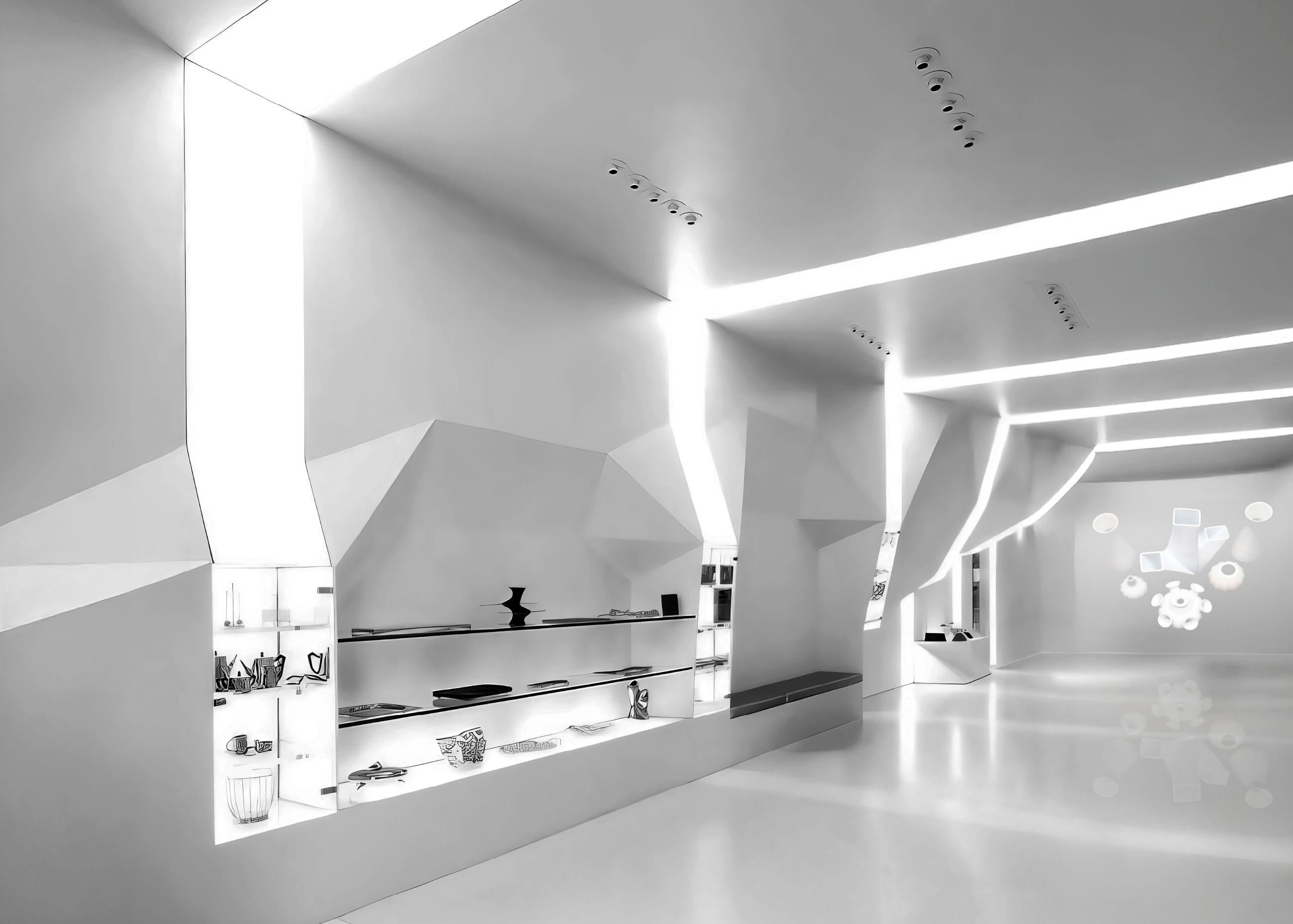
The showroom’s material palette deliberately mirrored the A3’s own vocabulary. A narrow entry corridor introduced visitors through a curving wall upholstered in vivid red textile, the same fabric family available for the workstation screens, creating a tactile, bodily encounter with the product’s materiality before any workstation came into view. Beyond, the floor, walls, and ceiling resolved into a continuous white field, a blank canvas that allowed the A3’s colored translucent screens, yellow, orange, blue, grey, to register as chromatic events in an otherwise neutral environment. Lighting was even and diffused, eliminating shadows and reinforcing the gallery atmosphere.
Exhibition as Argument
The NeoCon installation made an argument that went beyond any single product. By treating a furniture launch as an architectural project, with the same attention to sequence, atmosphere, materiality, and spatial narrative that the firm brought to its buildings, Asymptote demonstrated that the boundary between architecture, exhibition design, and product presentation was itself a design opportunity. The A3 system, featured in Metropolis magazine and subsequently exhibited at the Centre Pompidou in Paris, would go on to be recognized as one of the most ambitious attempts by architects to fundamentally rethink the furniture of work. The NeoCon showroom was its first public stage, and the installation ensured that the debut matched the ambition of the object.