Design · 1999 · Realized
Knoll A3 Furniture System
A radical rethinking of the office workstation for Knoll International, the A3 system replaces the rigid geometry of the cubicle with fluid, tent-like enclosures that reimagine how people inhabit the contemporary workplace.
About the project
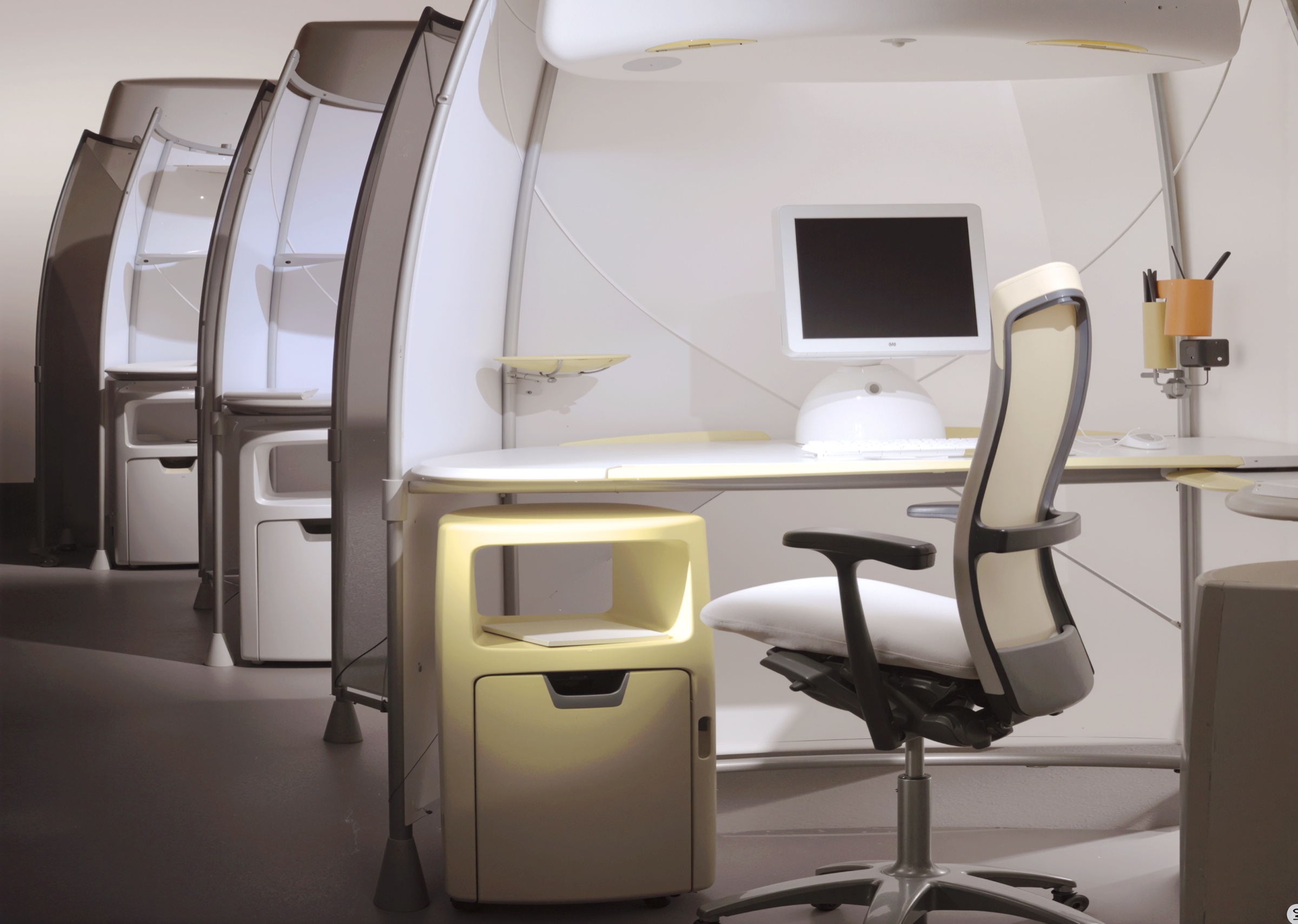
The A3 Furniture System, designed in collaboration with Knoll International, represents Asymptote Architecture’s entry into the realm of industrial and product design at the scale of the workplace. Conceived as a fundamental challenge to the ubiquitous office cubicle, the A3, shorthand for “anti-cube”, abandons the orthogonal logic of conventional systems furniture in favor of curvilinear, organically derived forms that redefine the spatial and experiential qualities of the open-plan office.
Concept
The project emerged from a provocation: could the rigid partitions and rectilinear modules that had defined office interiors for decades be entirely reconceived? Rather than beginning with the panel, the basic unit of every systems furniture line since Robert Propst’s Action Office, Asymptote approached the workstation as an architectural problem, thinking spatially and environmentally rather than in terms of discrete components. The result is a workstation that reads less as furniture and more as a micro-environment, a soft enclosure whose translucent screens stretch across elliptical steel frames to envelop the user in a cocoon of filtered light and calibrated privacy.
Design
The formal language of the A3 draws on sources far removed from the office furniture industry. The overhead storage unit, mounted above the worksurface like a streamlined fuselage element, takes its cue from the overhead luggage bins of commercial aircraft, a knowing reference to the designers’ own itinerant working lives and to the broader culture of mobility that was reshaping the early twenty-first-century workplace. The worksurfaces, screens, and frames can be ordered as complete workstations, eliminating the complex component-by-component specification process typical of conventional systems and enabling rapid reconfiguration as teams and tasks evolve.
Materiality and Sustainability
Each A3 workstation is completely recyclable and carries significantly lower overall mass than traditional systems furniture, an early commitment to material efficiency that anticipated the sustainability imperatives now central to the industry. The translucent screen material admits ambient light while providing acoustic and visual separation, striking a balance between the need for individual concentration and the desire for openness and collaboration. At scale, a floor of A3 workstations resembles not the familiar grid of cubicle walls but rather a tented city, a landscape of soft, luminous enclosures whose organic silhouettes introduce a sense of movement and rhythm into the office environment.
Significance
The A3 system stands as one of the most ambitious attempts by architects, rather than industrial designers, to fundamentally rethink the furniture of work. Exhibited at the Centre Pompidou in Paris and widely published at the time of its release, the project demonstrated that the tools and sensibilities of contemporary architecture, parametric modeling, spatial thinking, material innovation, could yield genuinely new typologies at the scale of the object. For Asymptote, the A3 remains a touchstone project, evidence that the boundary between architecture and design is not a limit but a productive threshold.