Design · 2008 · Realized
UBU · FUGU · ROI.MGX
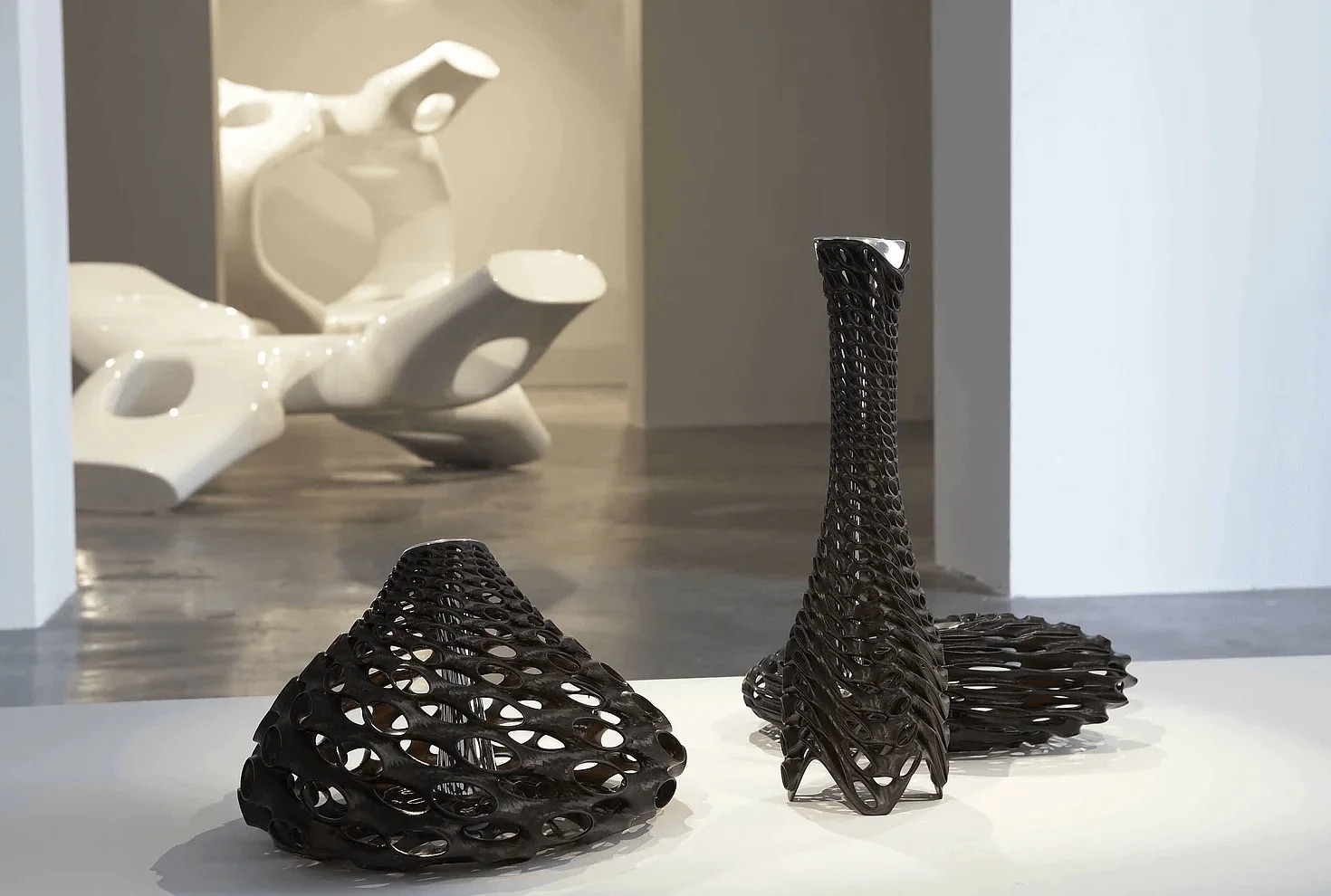
Three vases produced for MGX by Materialise using stereolithography and selective laser sintering, Ubu, Fugu, and Roi are algorithmically perforated vessels in black epoxy and chromed nylon, among the earliest design objects manufactured entirely through additive fabrication.
About the project
The Ubu, Fugu, and Roi vases were produced for MGX by Materialise, the Belgian company that in 2003 became one of the first to challenge leading designers and architects to use additive manufacturing not for prototyping but for the production of finished consumer objects. Founded by Wilfried Vancraen in 1990 as one of Europe’s earliest stereolithography bureaus, Materialise had spent over a decade refining the precision and surface quality of its laser-based fabrication systems before launching the .MGX label, a platform that invited figures including Patrick Jouin, Zaha Hadid, Amanda Levete, and Arik Levy to explore what was possible when the constraints of molds, tooling, and assembly were removed entirely. Asymptote’s contribution to the program, three vases whose perforated surfaces could not exist through any conventional means of manufacture, arrived in 2008, at a moment when additive fabrication was still largely unknown outside the engineering world.
Design
The three vases, Ubu, Fugu, and Roi, share a formal vocabulary rooted in Asymptote’s computational experiments with algorithmically generated surfaces. Each vessel is defined by a continuous shell perforated with apertures whose size, spacing, and orientation are not decorative decisions but the output of parametric scripts that respond to the curvature, structural load, and visual density of the form at every point. Fugu takes its name from the Japanese pufferfish and shares something of that creature’s inflated, spined geometry, a broad, conical body tapering to a narrow mouth, its surface swirling with elliptical voids that suggest constant rotation. Ubu, named in reference to Alfred Jarry’s absurdist play, is more compact and bulbous, its perforations arranged in bands that follow the torsion of the underlying surface. Roi, the tallest of the three at twenty-two inches, rises on a slender, lattice-like stem that flares into a wide lip, the openings in its wall so dense that the object reads less as a vessel than as a frozen field of turbulence.
Fabrication
Each vase is produced through a combination of two additive processes. The outer shell is built in black epoxy resin using stereolithography, a technique in which a UV laser traces each cross-section of the form onto the surface of a liquid resin bath, curing it layer by layer into a solid with the resolution to capture the finest details of the algorithmic perforations. The interior insert, visible through the lattice, is manufactured in polyamide using selective laser sintering, a process in which a laser fuses powdered nylon particles into a solid form, here finished in chrome to create a reflective inner surface that catches and multiplies light through the surrounding openings. The dialogue between the matte black exterior and the gleaming interior is central to the objects: the vases shift between opacity and transparency, solidity and dissolution, depending on the viewer’s angle and the quality of the ambient light.
Significance
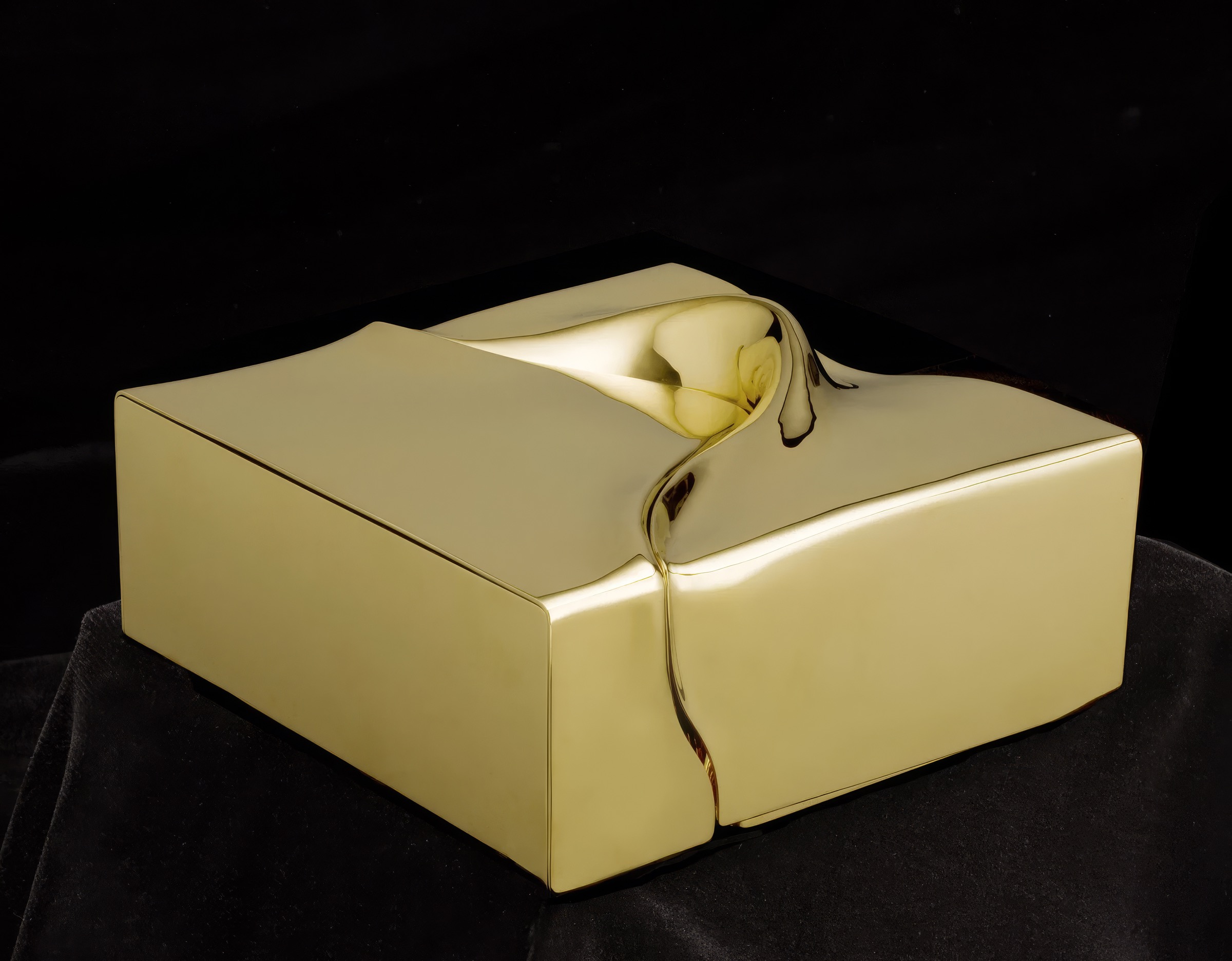
The vases were first exhibited at Atmospherics, Hani Rashid’s solo show at Phillips de Pury & Company in New York in the summer of 2008, alongside the Ivo table, LQ Chandeliers, gold Mnemos boxes, and a series of M-scape sculptures, works that Rashid has described as hybridized conditions between art, design, and architecture. The MGX pieces subsequently appeared in the .MGX e-volution exhibition at Moss, the influential New York design gallery, in 2009, where they joined works by Jouin, Levy, Levete, and others in what amounted to a survey of the first decade of serious 3D-printed design. Within Asymptote’s own trajectory, the vases extend a longstanding interest in the relationship between computational form and physical materiality, the proposition that the geometries generated on screen need not be simplified or compromised for manufacture, but can now, through additive processes, be realized with a fidelity that subtractive and formative methods could never achieve.