Design · 2008 · Realized
MNEMOS, Jewel and Collectable Boxes
A trio of gold boxes commissioned by Meta as contemporary heirs to the precious boxes of the eighteenth century, each Mnemos is a microarchitecture in solid gold or vermeil, its surface generated by simulating molten gold cascading over form, then frozen in time.

About the project
The Mnemos collection, three unique boxes for jewelry, cigars, and keepsakes, was commissioned by Meta, the contemporary design platform launched in 2008 by Mallett, the distinguished Bond Street antiques house founded in 1865 and long regarded as one of the world’s foremost specialists in eighteenth-century furniture and objects. Meta’s ambition was to bridge centuries: to place living designers in dialogue with historical materials, techniques, and typologies that the market had largely consigned to museum vitrines. For Asymptote, this meant confronting one of the most refined genres in the decorative arts, the precious box, an object whose production in gold and silver during the 1700s demanded the highest convergence of craft, material science, and miniature spatial thinking.
Concept
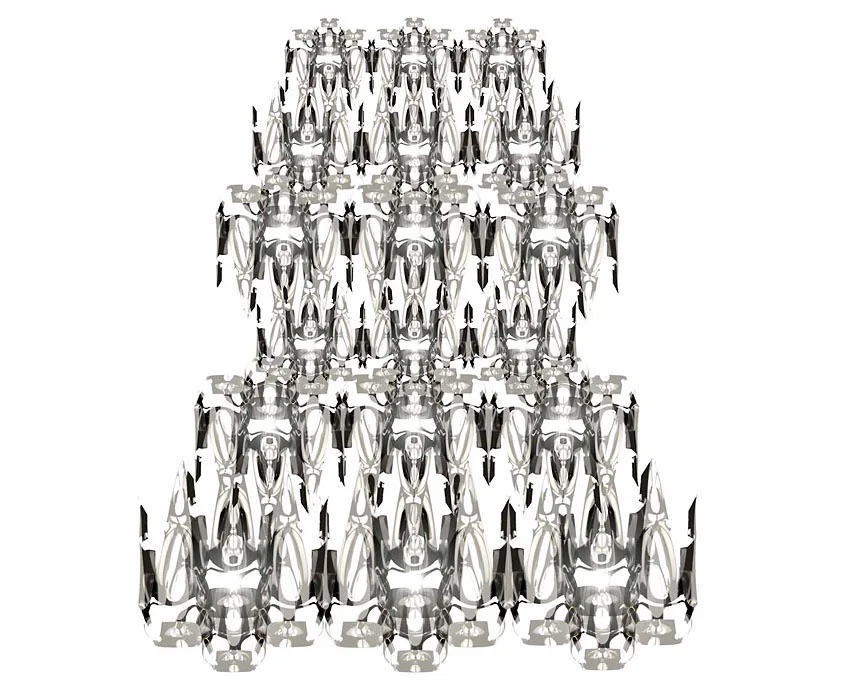
Hani Rashid has described the Mnemos boxes as microarchitectures, objects that operate at the scale of the hand but embody the same formal logic, spatial complexity, and computational rigor that Asymptote brings to buildings and urban plans. The design process began digitally: virtual models simulated the behavior of molten gold dripping and cascading over prismatic box forms, the fluid captured at a precise instant and frozen in time. The resulting surfaces are neither decorative pattern nor arbitrary texture but the recorded physics of a viscous material responding to gravity, surface tension, and the geometry of the object beneath. Each droplet, each rivulet, each pooling edge is the trace of a computed event.
Craft
Translating these digital surfaces into physical objects required collaboration with a pre-eminent Parisian atelier specializing in the finest hand-made metalwork. The computer-generated forms were realized entirely by hand, in solid gold for Mnemos 01, and in vermeil (gold over sterling silver) with satinwood and kid leather interiors for Mnemos 02 and 03. The hinges, closures, and joints, always the measure of a master goldsmith’s skill, had to accommodate Asymptote’s irregular, flowing surfaces while maintaining the precision expected of a luxury box that opens and closes with the weight and certainty of a vault. The three boxes vary in scale: the largest approximately ten inches square, the smallest fitting in the palm of a hand, each unique and unrepeatable.
Significance
The name Mnemos derives from Mnemosyne, the Greek goddess of memory, an apt reference for objects conceived as repositories, vessels in which the most valued small possessions are stored and, by extension, remembered. Exhibited first at Atmospherics, Hani Rashid’s solo show at Phillips de Pury & Company in New York in the summer of 2008, and subsequently at Design Miami during Art Basel Miami Beach that December, where they appeared alongside Mallett’s own collection of rare historical works in an installation titled Meta: Masterpieces and Materials Past and Present, the Mnemos boxes demonstrated that the boundary between art, design, and architecture could be productively collapsed even at the most intimate scale. They are in private collections.