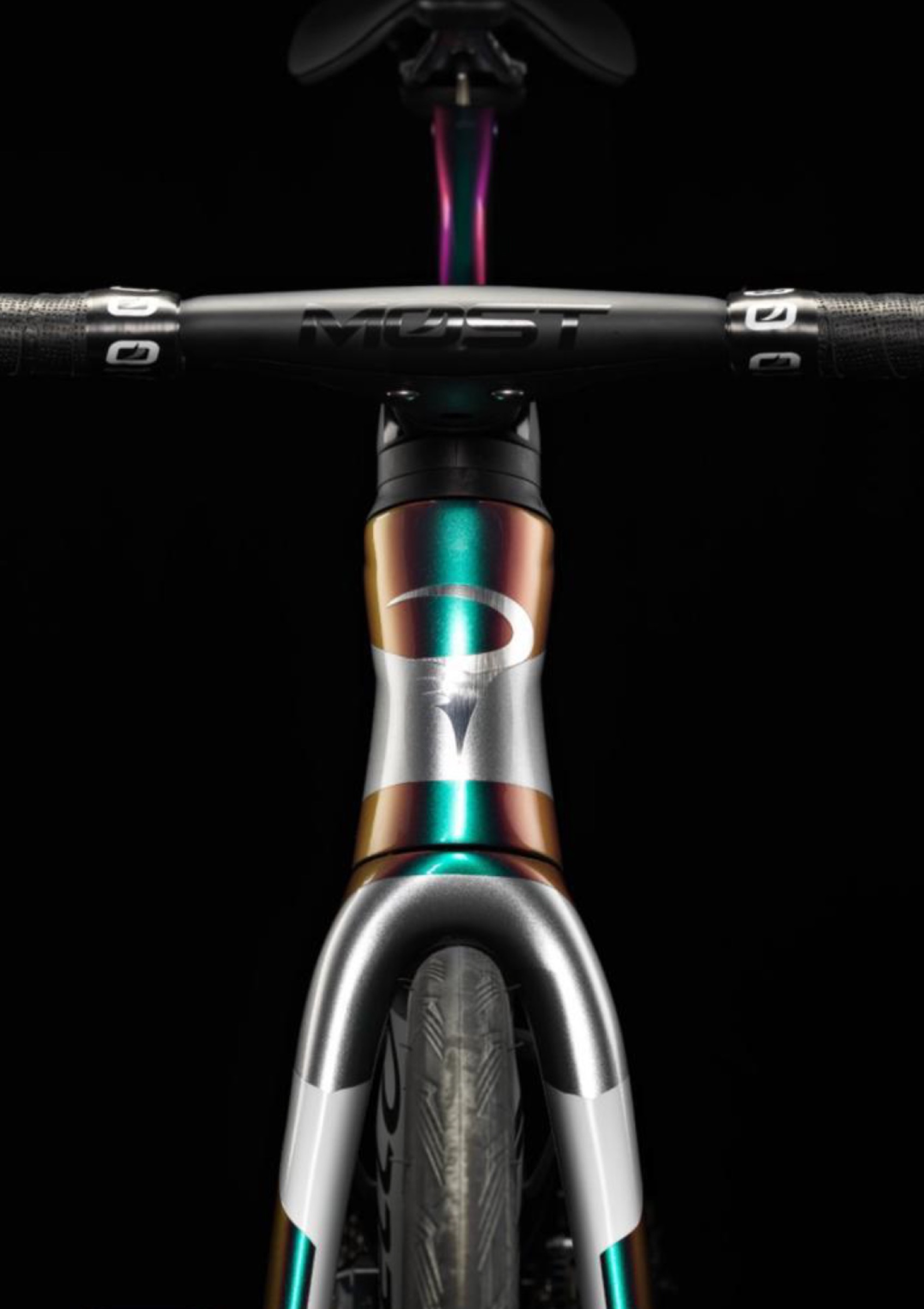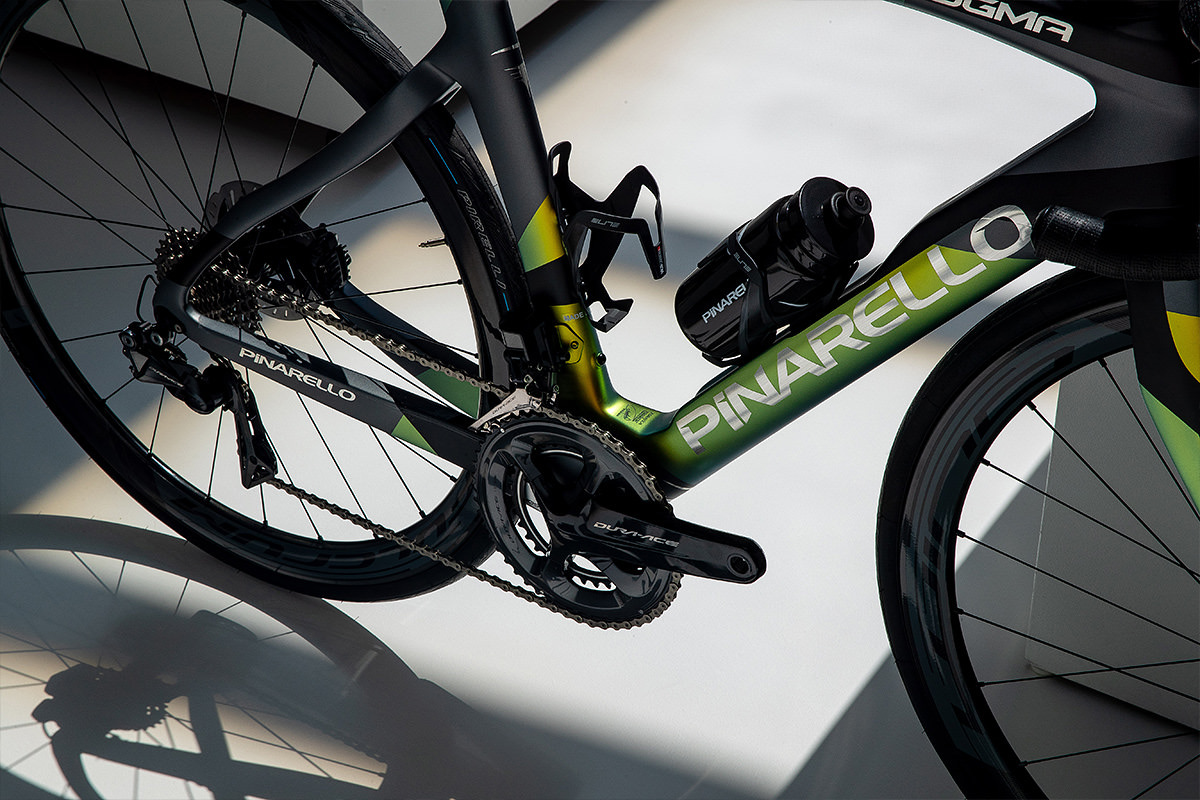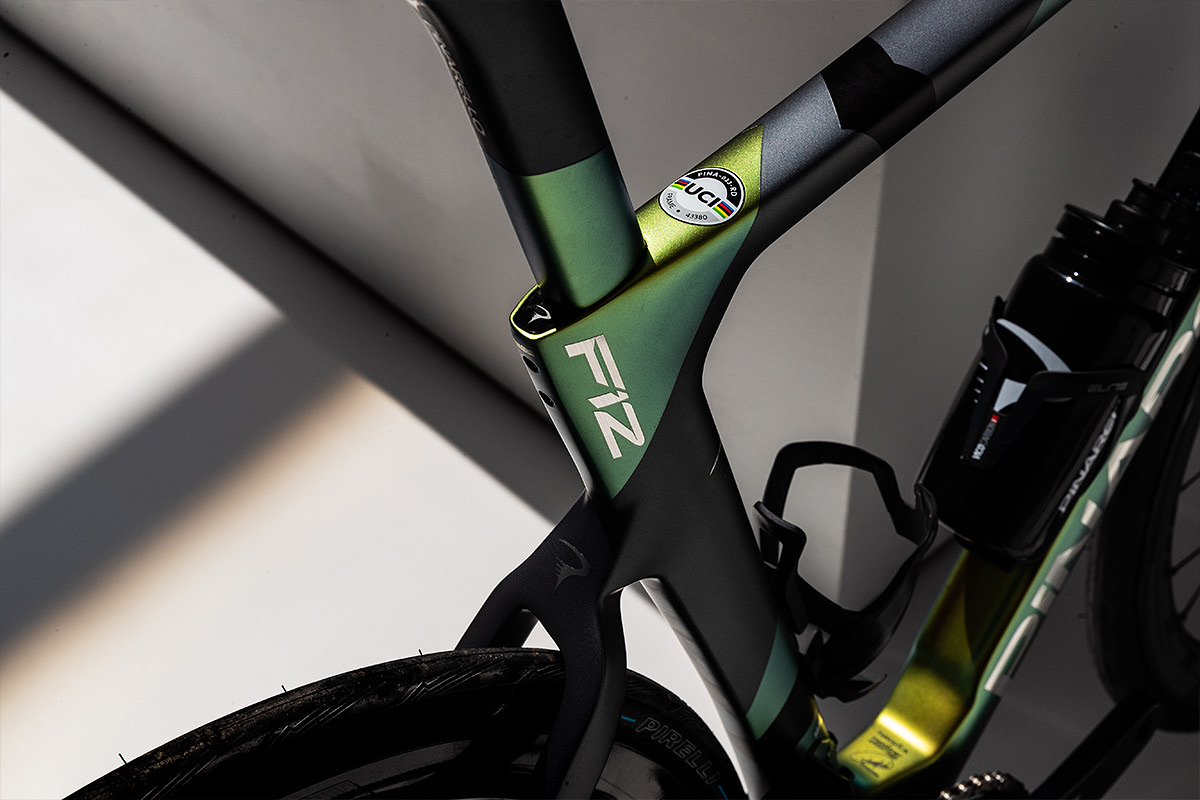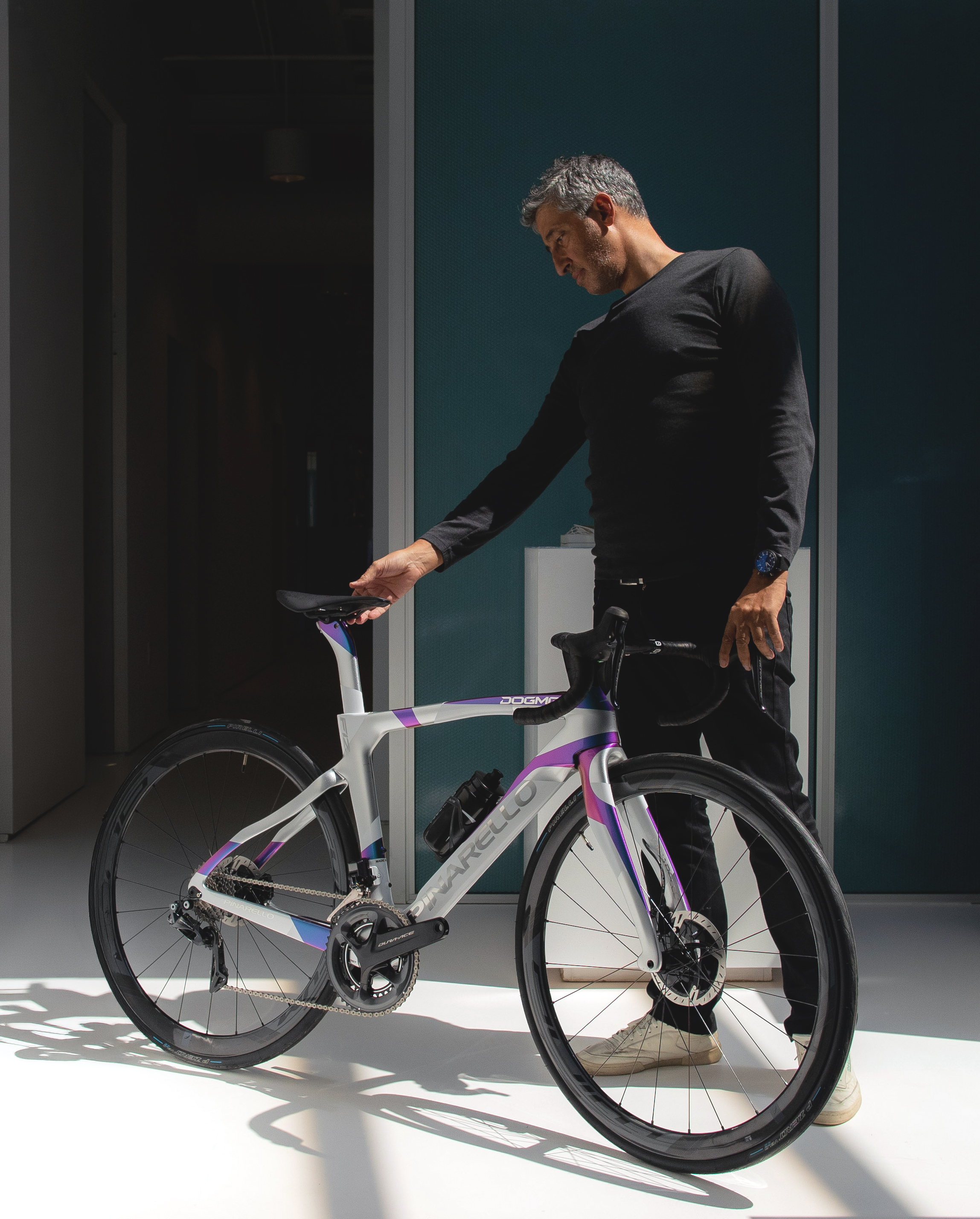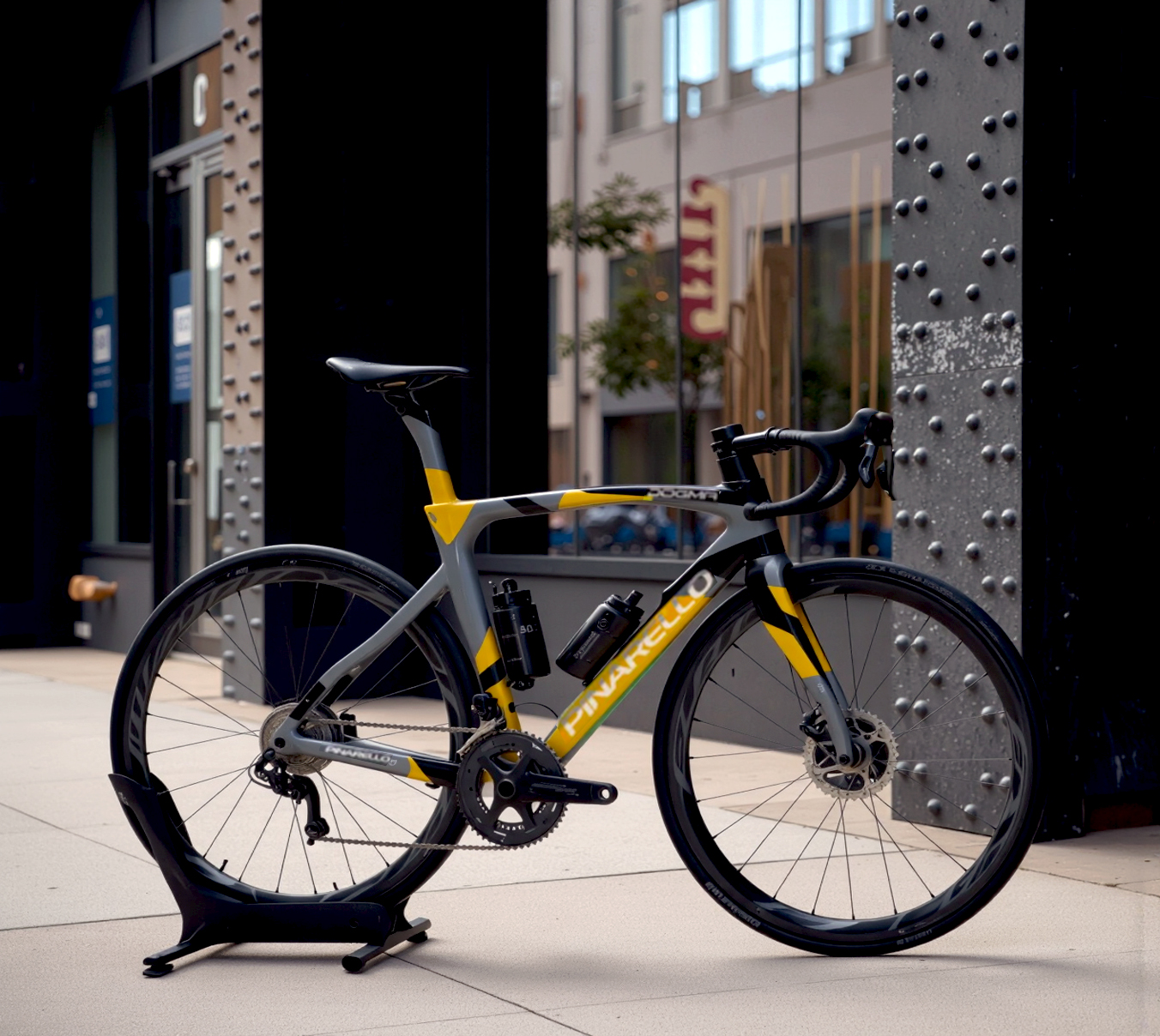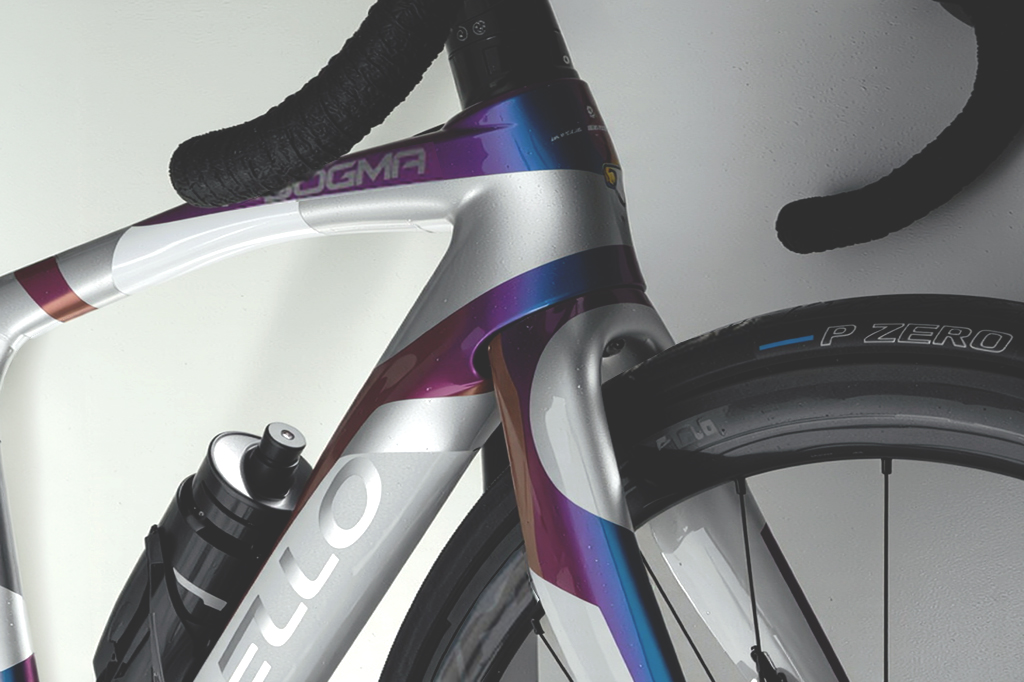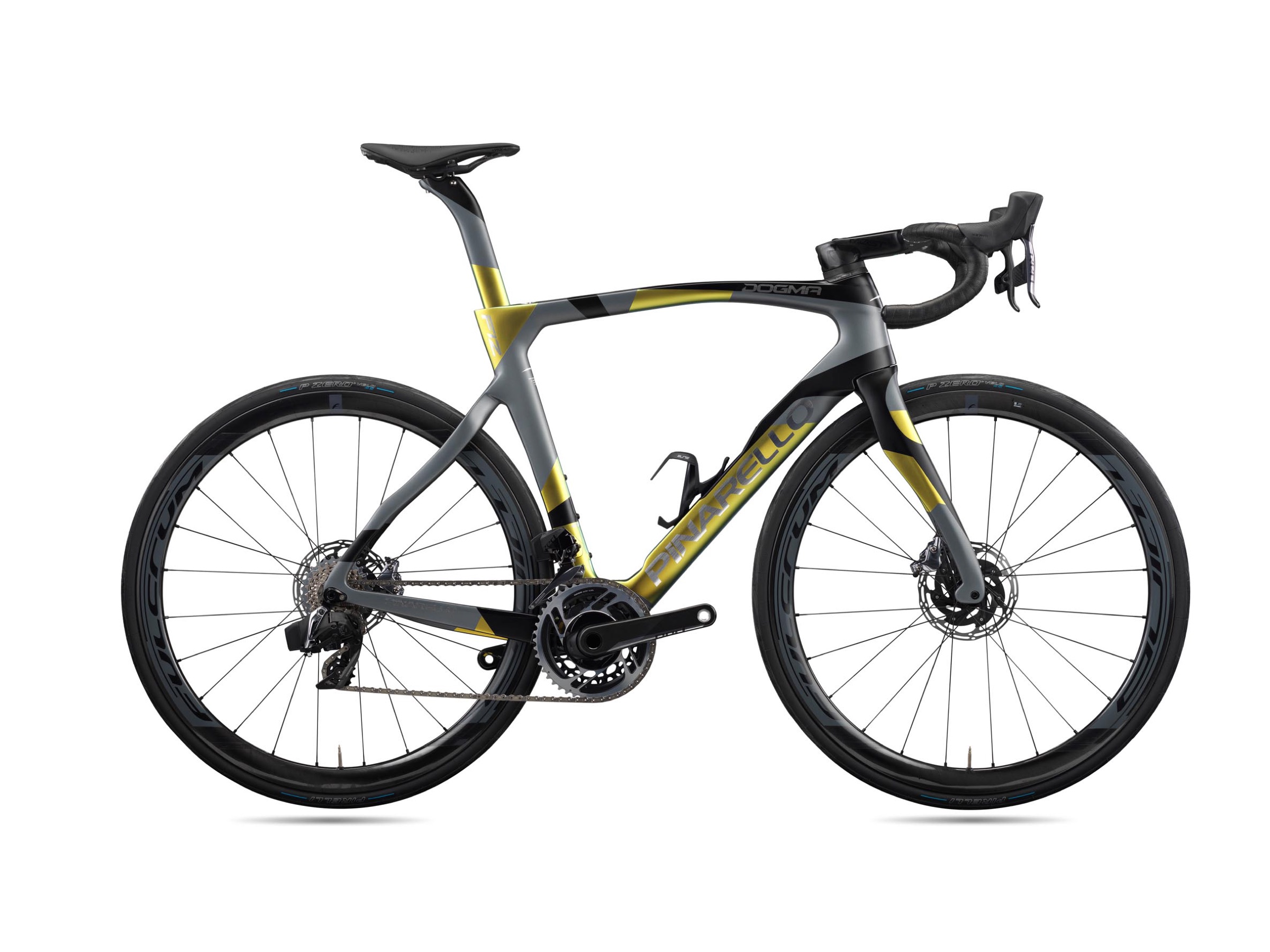
Two limited-edition Dogma F12 racing bicycles designed in collaboration with Fausto Pinarello — their carbon fiber frames wrapped in iridescent, architecturally mapped color fields drawn from the geology of the Dolomites, with only twelve units ever produced.
The Pinarello × Hani collaboration grew from a long friendship between Hani Rashid and Fausto Pinarello, the patriarch of the Italian cycling dynasty whose factory in Treviso has produced frames for seven of the last ten Tour de France winners. Pinarello had for years invited Rashid to bring an architect’s eye to the bicycle — an object that, like a building, must reconcile aerodynamic performance with structural efficiency, material economy with the demands of the human body in motion. In 2020, the two realized that ambition: a limited edition of the Dogma F12, Pinarello’s flagship racing platform, whose frame surfaces became the canvas for an exercise in architectural color and geometry that transformed one of the most technically advanced bicycles in the world into something that belongs as much in a gallery as on the road.
The Dogma F12
The Dogma F12 is itself a work of engineering architecture. Its frame is laid up in Torayca T1100 1K Dream Carbon with Nanoalloy technology — the highest-grade aerospace fiber available — and formed around an asymmetric geometry that compensates for the unequal forces generated by the drivetrain pulling on the right side of the frame alone. Every tube profile, every junction radius, every wall thickness is the output of computational fluid dynamics and finite-element analysis refined over decades of Grand Tour racing. The fork, Pinarello’s proprietary ONDA F12, continues this logic into the steering assembly, while the frame’s total internal cable routing — the TICR system — eliminates all external lines, leaving the surfaces uninterrupted and aerodynamically clean. It was this engineering clarity that attracted Rashid: a frame whose form is entirely determined by performance, and whose surfaces therefore carry the same kind of inevitable geometry that an architect recognizes in a well-resolved structure.
Design
Rashid’s intervention was not to alter the frame’s geometry — which is, after all, the product of wind-tunnel testing and Grand Tour victories — but to reveal and amplify it through color. He began by tracing and mapping the mathematical contours of the F12’s tubes, junctions, and transitions, reading the frame the way an architect reads a facade: as a field of surfaces whose curvatures, inflections, and structural logic can be made visible through the application of light and material. Working with Pinarello’s paint technicians and graphic designers in Treviso, Rashid developed two distinct colorways, each inspired by the Dolomites — the mountain range that has defined Italian cycling since the Giro d’Italia first crossed its passes in 1937 and that rises within sight of the Pinarello factory itself.
The first palette draws from summer and autumn in the high peaks: deep shadows yielding to glinting gold light washing over rugged stone, the warm ochres and burnt umbers of mountain walls at sunset. The second evokes winter and spring: snow-capped ridgelines against azure skies, silver stone faces fractured by ice and meltwater. Both finishes combine matte and glossy surfaces in iridescent layers that shift with viewing angle — colors that vibrate across the frame’s three-dimensional architecture rather than simply sitting on a flat decal. The result is a paint application that reads differently from every position: head-on, the frame presents one set of tonal relationships; in profile, another; from above, as a rider would see it, yet another still.
Production
Only twelve Dogma F12 frames were produced in the Pinarello × Hani edition — a number that places them among the rarest production bicycles ever made. The first two, built up as complete race-ready machines in 53-centimeter and 46.5-centimeter sizes, were exhibited at Strictly Cycling Collective in New York before being auctioned on eBay to benefit World Bicycle Relief, the international non-profit that distributes bicycles in developing countries for education, healthcare, and economic development. The remaining ten frames were allocated to select Pinarello dealers worldwide. Each bike was accompanied by a coffee-table book documenting the collaboration, with personal notes from both Rashid and Fausto Pinarello.
Significance
The Pinarello × Hani edition extends a principle that runs through all of Rashid’s product work — from the Alessi Desktop Architecture collection to the M-Scape sculptures to the Ivo table for META: that architecture is not bound to a particular scale, and that the spatial intelligence brought to a building operates with equal validity at the scale of objects nearest the body. A racing bicycle, like a skyscraper, is a structure shaped entirely by forces — aerodynamic, gravitational, muscular — and its form, when resolved with sufficient precision, achieves the same quality of inevitability that architects seek in their best work. Rashid’s contribution was to make that kinship visible: to treat the frame not as a surface to be decorated but as an architecture to be read, its geometries amplified through color in the same way that light reveals the logic of a well-designed facade. The collaboration also deepened a broader relationship with Pinarello that would lead to the design of the Cicli Pinarello Factory and Headquarters in Treviso — a building whose own aerodynamic forms draw directly from the engineering language of the bicycles manufactured within it.