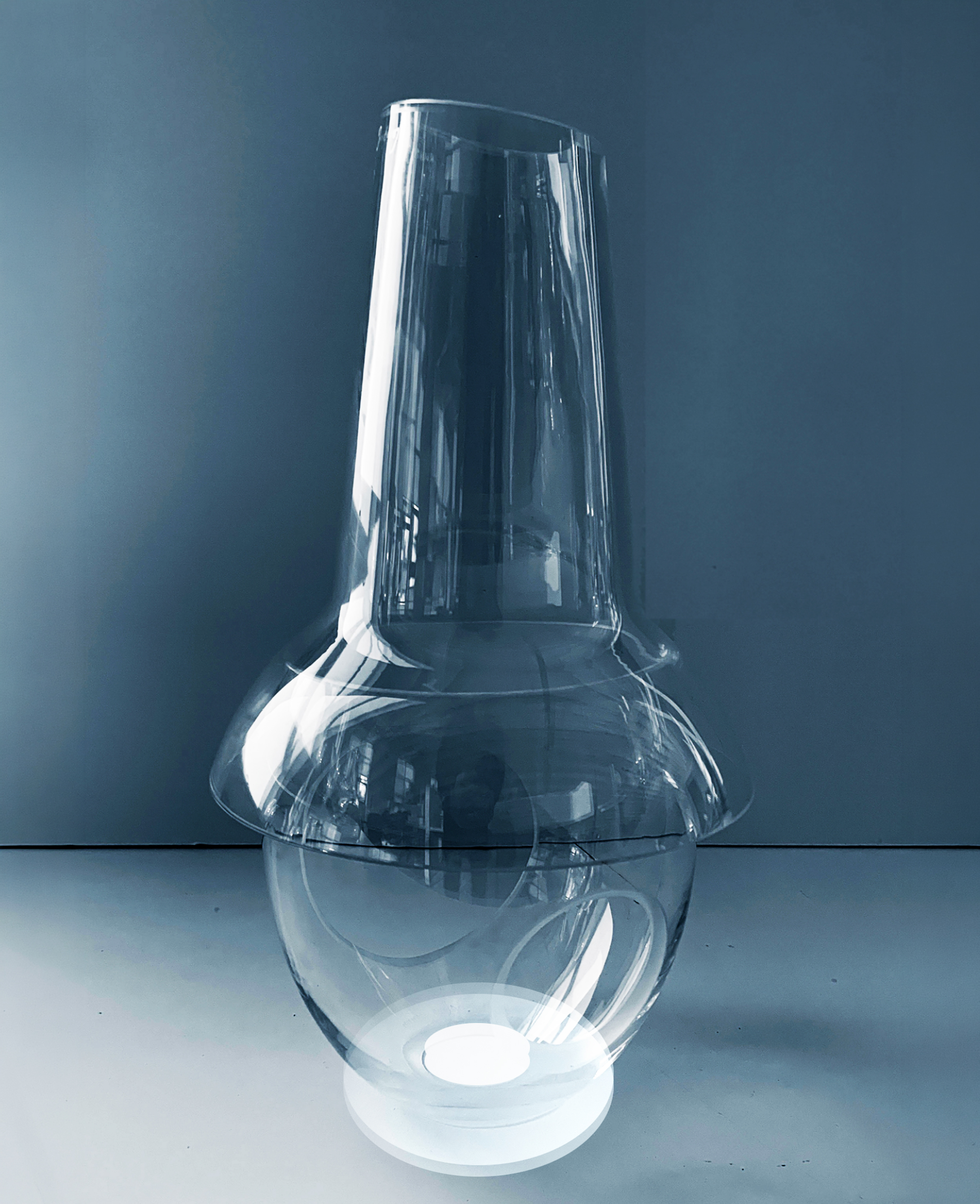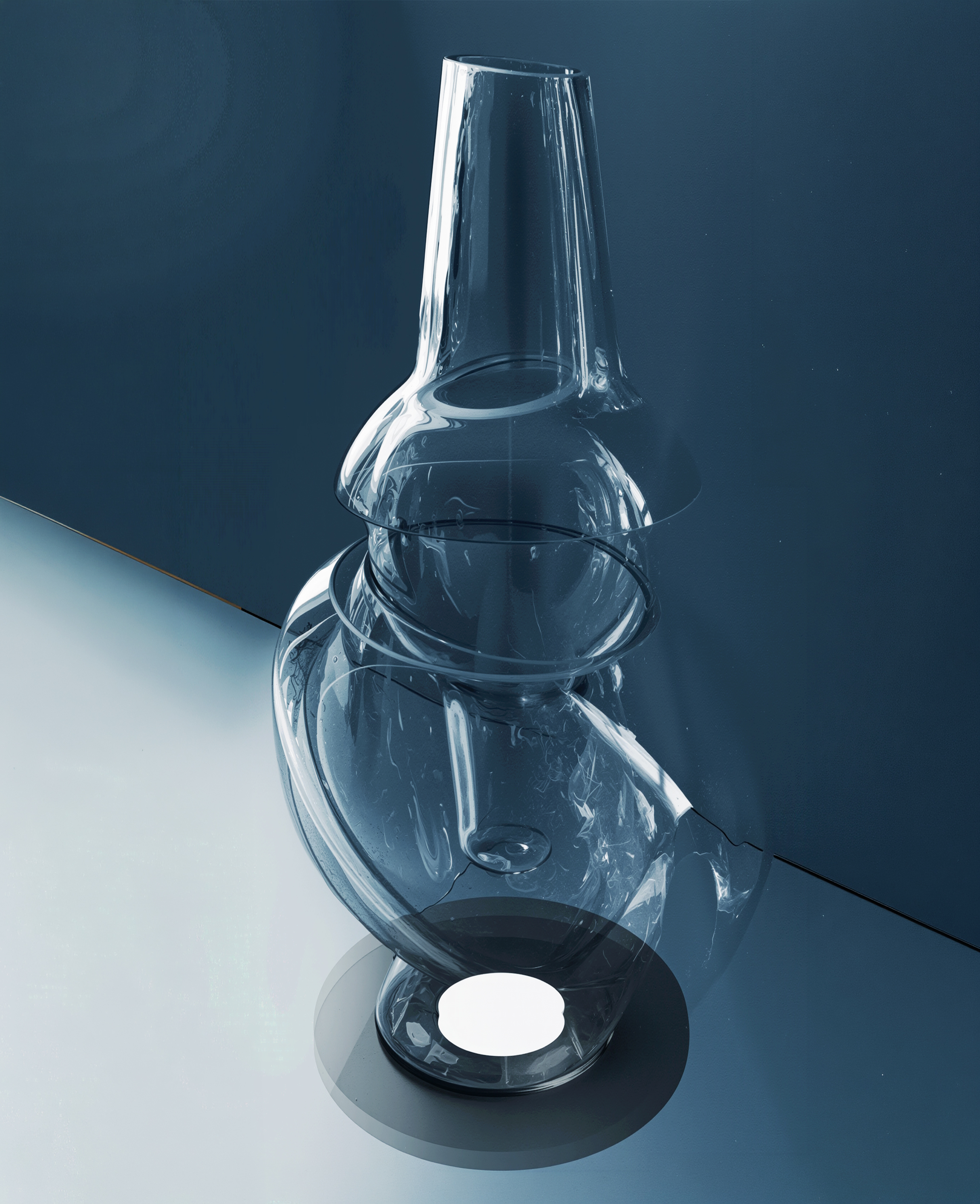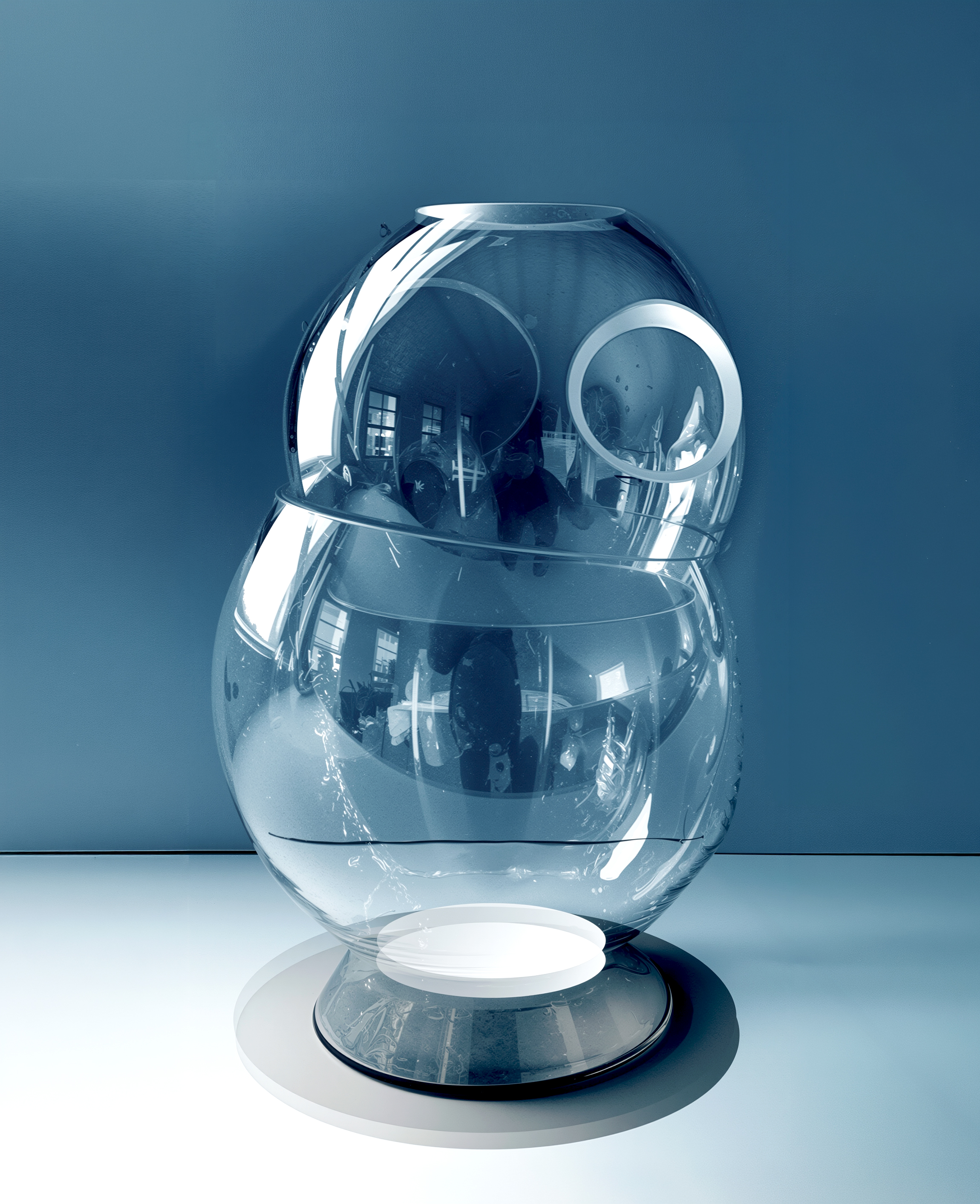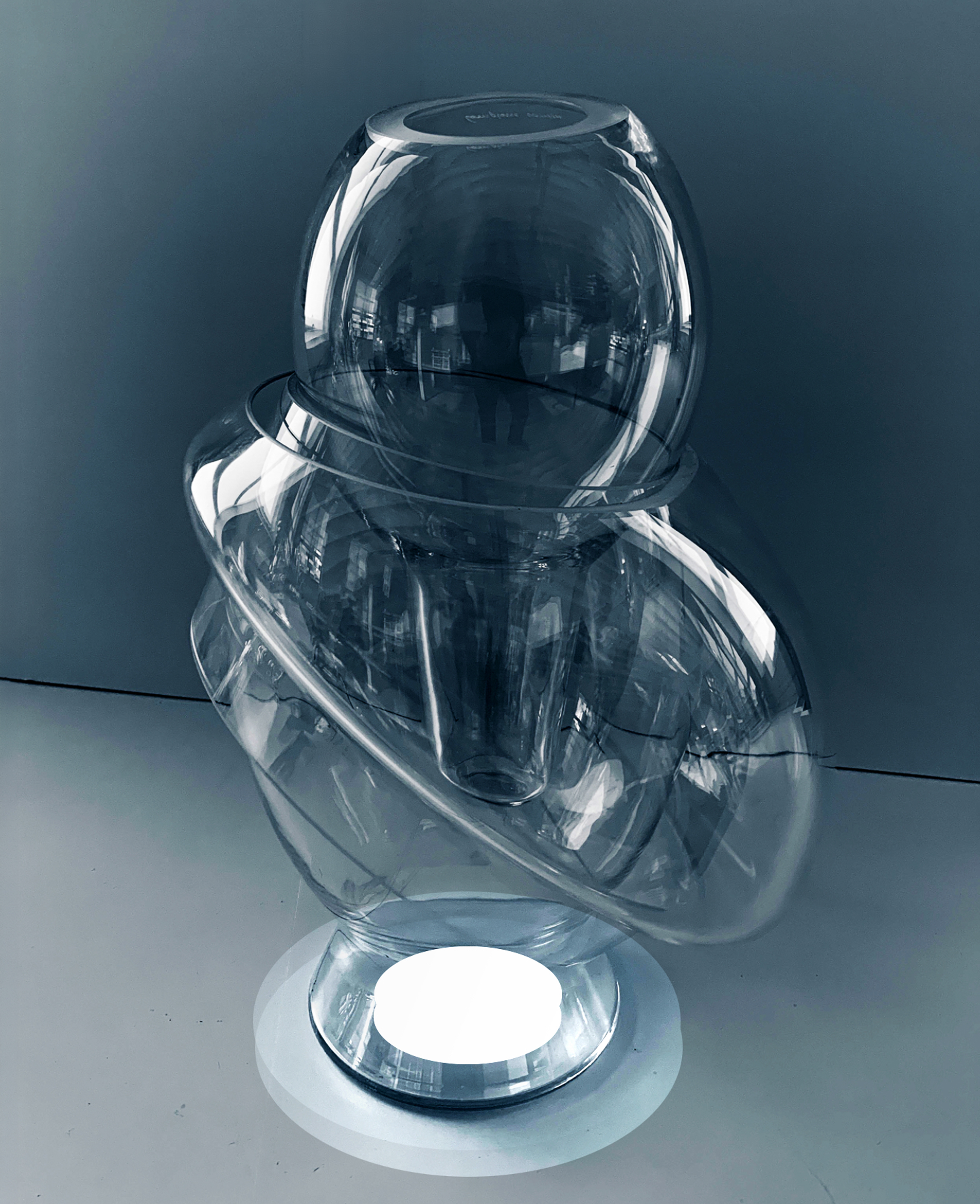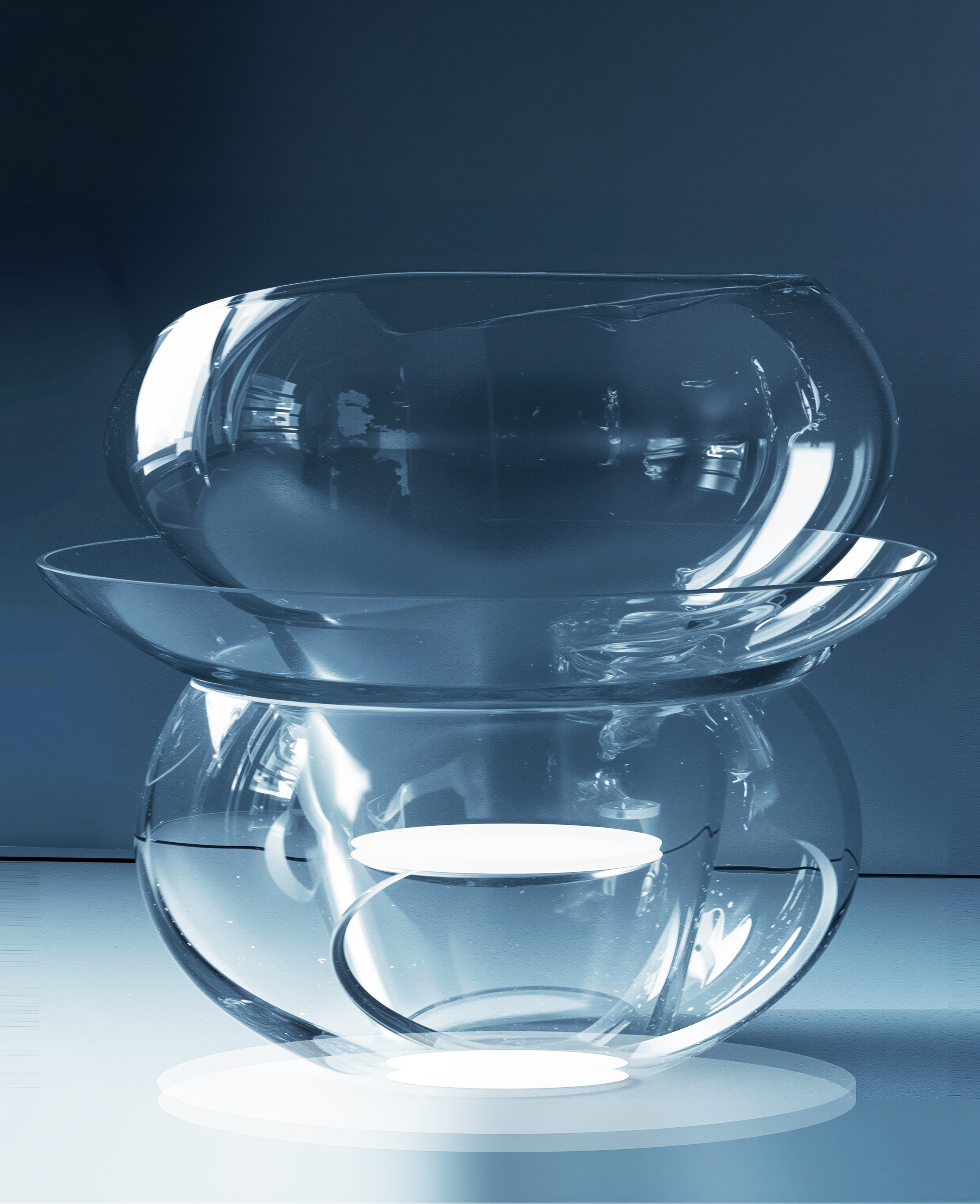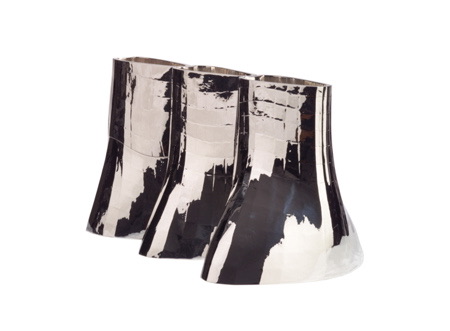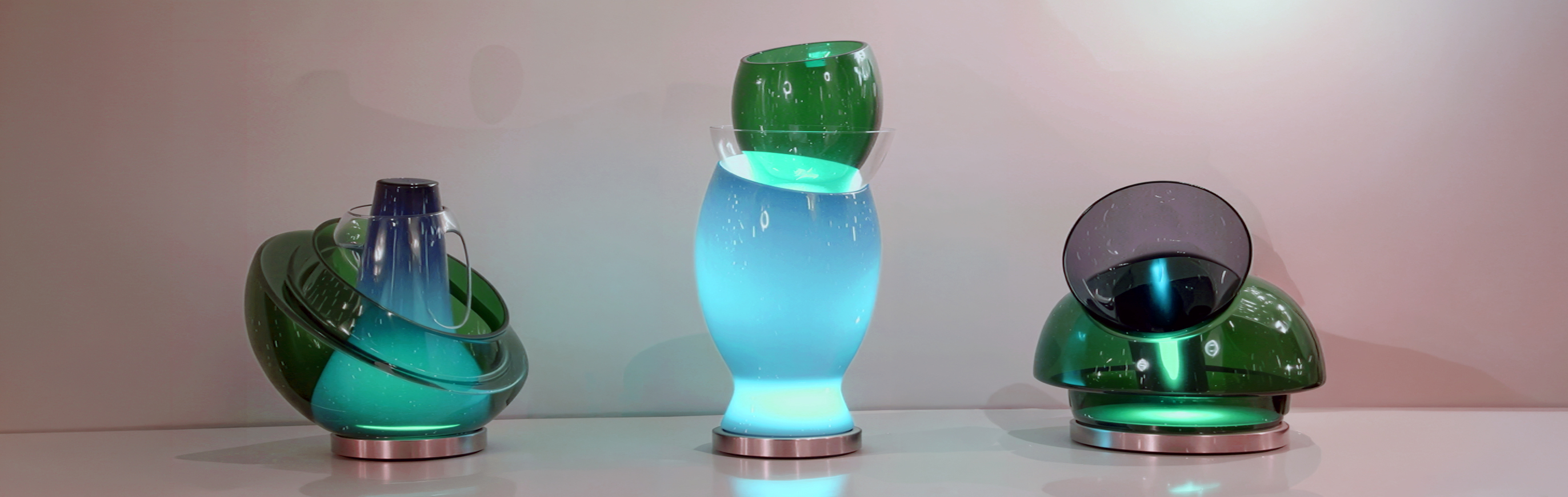
A suite of luminous glass sculptures for Venini — hand-blown on Murano in centuries-old tradition, each piece named after an atmospheric optical phenomenon and designed to make visible the inherent beauty of light passing through glass.
Venini invited Asymptote to design a collection of glass objects that would extend the firm’s architectural thinking into the material most synonymous with light itself. Founded in 1921, Venini has collaborated with architects and artists for over a century — Carlo Scarpa, Gio Ponti, Ettore Sottsass, Tadao Ando, Ron Arad — and the invitation placed Asymptote in a lineage of designers who have pushed Murano glass beyond ornament and into the territory of spatial experience. The result was Luminosita: a suite of table-scale light sculptures whose forms draw on the sculptural architecture of André Bloc and Friedrich Kiesler and the sensual geometries of Constantin Brancusi, rendered in hand-blown glass by the master glassblowers of Murano.
The Collection
Luminosita comprises four pieces, each named after a real atmospheric optical phenomenon — the fleeting conditions under which light, air, and moisture conspire to produce effects visible only at certain latitudes, altitudes, or moments of the day.
Ice Blink takes its name from the phenomenon observed in polar regions where the icy horizon meets an overcast sky and a thin band of white luminance appears along the boundary — a navigational signal used by Arctic peoples and Northwest Passage explorers to locate pack ice from a distance. The piece renders this threshold condition in glass: a softly glowing horizon line suspended within a translucent volume mounted on a brushed nickel base. Available in Horizon/Orange, Horizon/Indigo, Horizon/Light Pink, and Horizon/Opaline Light Pink.
Belt of Venus refers to the band of pink-orange light visible just above the horizon during civil twilight, separated from the earth by the darker blue of the planet’s own shadow. The glass captures this chromatic stratification — warm tones floating above cooler depths — in a form whose curvature recalls both atmospheric optics and the topology of Asymptote’s architectural surfaces.
Water Sky is the dark reflection cast on the underside of low clouds by open water surrounded by ice — a dark patch on an otherwise bright sky that told Arctic navigators where leads and polynyas lay ahead. The piece translates this inverted luminance into glass: light absorbed and re-emitted through colored volumes that darken and intensify toward their centres.
Mirage — the optical displacement of light refracted through layers of air at different temperatures — becomes in glass a form whose surfaces appear to shift and distort as the viewer moves around it, the LED source within creating the same kind of perceptual instability that desert and ocean mirages produce in the natural world.
Craft
Each piece is hand-blown on Murano using techniques that have been refined on the island for more than seven hundred years. The glass is gathered, shaped, and coloured at the furnace by Venini’s master glassblowers — a process in which every piece is unique, carrying the slight irregularities and tonal variations that distinguish hand-blown glass from industrial production. The forms are mounted on brushed nickel bases and illuminated by low-voltage LED sources that allow the glass to be experienced as architecture in miniature: volumes defined not by walls but by the passage of light through material.
Significance
The Luminosita collection was introduced at Euroluce 2019 during Milan Design Week and is available through Venini and authorized retailers worldwide. The collaboration extended Asymptote’s long-standing interest in the relationship between architecture and atmospheric effect — the same concern that drives the firm’s buildings, from the light-transmitting gridshell of the Yas Hotel to the LED-embedded facades of the Strata Tower — into an object that can be held in the hand. In Venini’s own catalogue, the collection sits under Art Light alongside works by some of the most significant architects and designers of the twentieth and twenty-first centuries, confirming what the pieces themselves make evident: that the boundary between architecture and the decorative arts, like the atmospheric phenomena for which these objects are named, is a matter of perception rather than fact.