Design · 2007 · Realized
LQ Chandelier
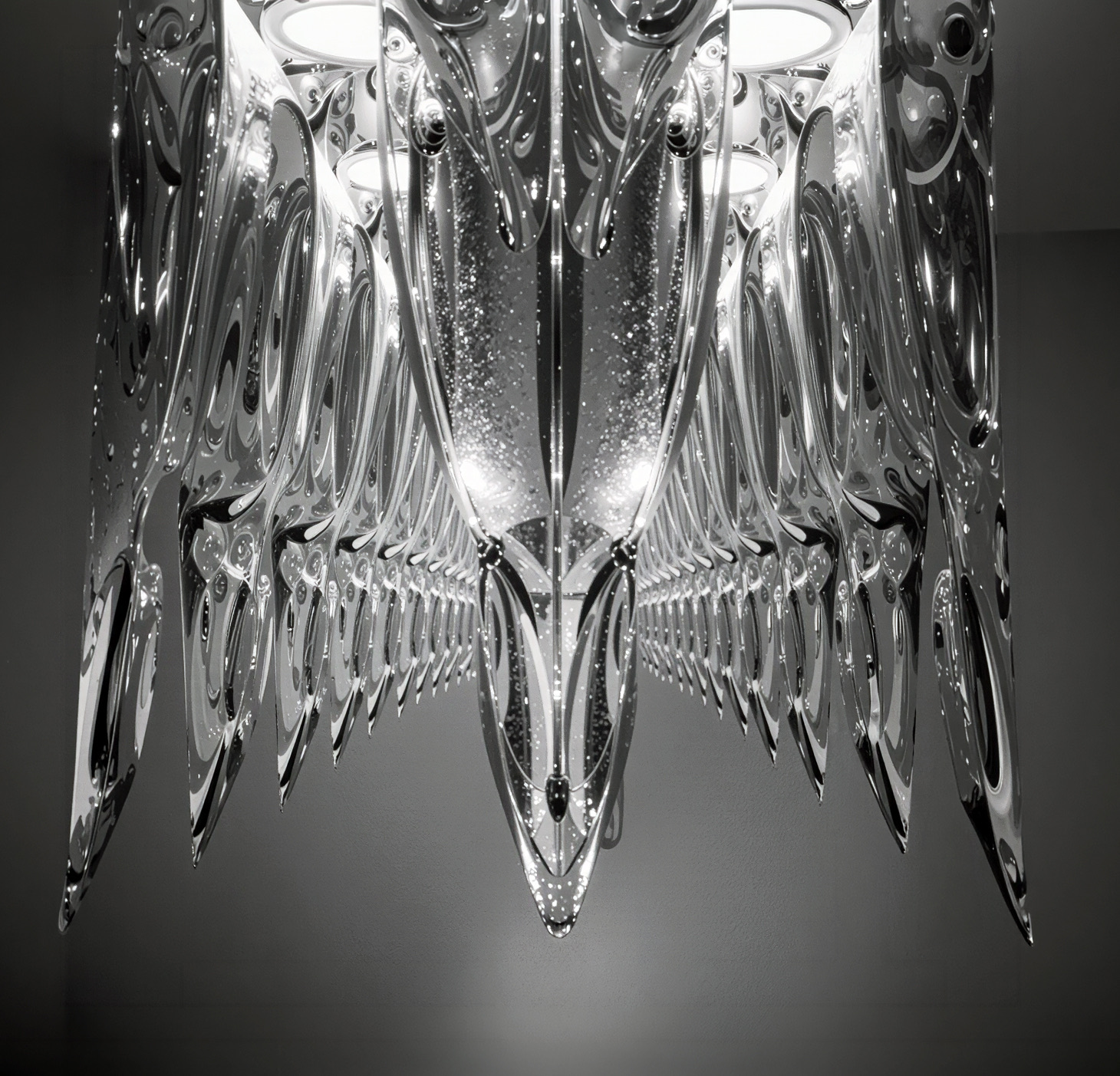
A contemporary reinvention of the chandelier for Zumtobel, the LQ system transforms a single minimal-surface component into an infinitely expandable constellation of chrome and light, each module concealing its LED source behind sculptural reflections.
About the project
The LQ Chandelier, designed by Hani Rashid for the Austrian lighting manufacturer Zumtobel, reimagines one of the oldest typologies in the decorative arts, the chandelier, through the lens of contemporary geometry, advanced LED technology, and modular logic. The name “LQ” is Rashid’s wry nod to Louis Quatorze, the Sun King, whose court at Versailles elevated the chandelier to an instrument of spectacle and power. Where the Baroque original deployed hundreds of candles and kilograms of crystal to flood a salon with light, the LQ achieves its luminous presence through precisely calculated reflection and a fraction of the energy.
Concept
The project began with a deceptively simple premise: could a single geometric surface, a minimal surface, in the mathematical sense, serve as both the structural and optical unit of a chandelier? Rashid’s answer is a tulip-shaped component whose chrome-plated interior facets act as a multifaceted reflector, bouncing light from a concealed LED cluster outward in complex, shifting patterns. The light source itself is invisible to the viewer; what one perceives is not illumination from a point but a diffused luminance that seems to emanate from the form itself.
Design
Each modular unit houses four LED boards arranged within a downward-opening chrome shell. The shell’s curves are not decorative but functional, derived from specific geometrical principles that maximize the interplay between direct and reflected light. Because the form is generated from a single minimal surface, each unit connects seamlessly edge-to-edge with its neighbors, allowing the chandelier to grow from a solitary pendant into sprawling sculptural assemblies: suspended ceilings, luminous walls, free-standing floor pieces. The system is, in effect, architecture at the scale of the lamp, a kit of parts whose aggregation transforms a utilitarian fixture into a spatial event.
Materiality
The material palette is deliberately restrained: injection-molded plastic plated in chrome, with steel suspension cords and transparent feed lines that all but disappear against the ceiling plane. Available in four color variants, the chrome finish turns each module into a small convex mirror, fragmenting and multiplying the surrounding room within its surface. The result is an object that is simultaneously opaque and reflective, solid and immaterial, qualities that have defined much of Rashid’s broader architectural practice.
Exhibitions and Recognition
Commissioned as the inaugural piece in Zumtobel’s Lighteriors Avant Garde Collection, a program that pairs leading architects and artists with advanced lighting technology, the LQ was first presented at the Milan Furniture Fair and subsequently exhibited at Design Miami during Art Basel Miami Beach in 2007. It joined a roster of Zumtobel Masterpieces alongside works by Olafur Eliasson, Zaha Hadid, and Daniel Libeskind, positioning the LQ within a broader discourse on the luminaire as a legitimate medium for architectural and artistic expression.