Design · 2007 · Realized
Tea & Coffee Service for Sawaya & Moroni
A sterling silver tea and coffee service designed for Sawaya & Moroni's Silver collection, fluid, architecturally sculpted vessels handcrafted by Italian silversmiths, presented at Milan Design Week in 2007.
About the project
The tea and coffee service for Sawaya & Moroni belongs to the firm’s celebrated Silver collection, a program that since the mid-1990s has commissioned leading international architects to design limited-edition tableware in sterling silver, handcrafted by master silversmiths in Milan. William Sawaya, an architect himself and co-founder of the company with Paolo Moroni in 1984, has long understood that architects bring to the domestic object a spatial intelligence distinct from that of the industrial designer: a tendency to think in volumes, sections, and the interplay of interior and exterior that transforms even the most familiar typology into something newly considered. The Asymptote service was presented at Milan Design Week in 2007 alongside works by Zaha Hadid and Massimiliano Fuksas, each architect bringing a distinct spatial sensibility to the intimate scale of silver tableware.
Design
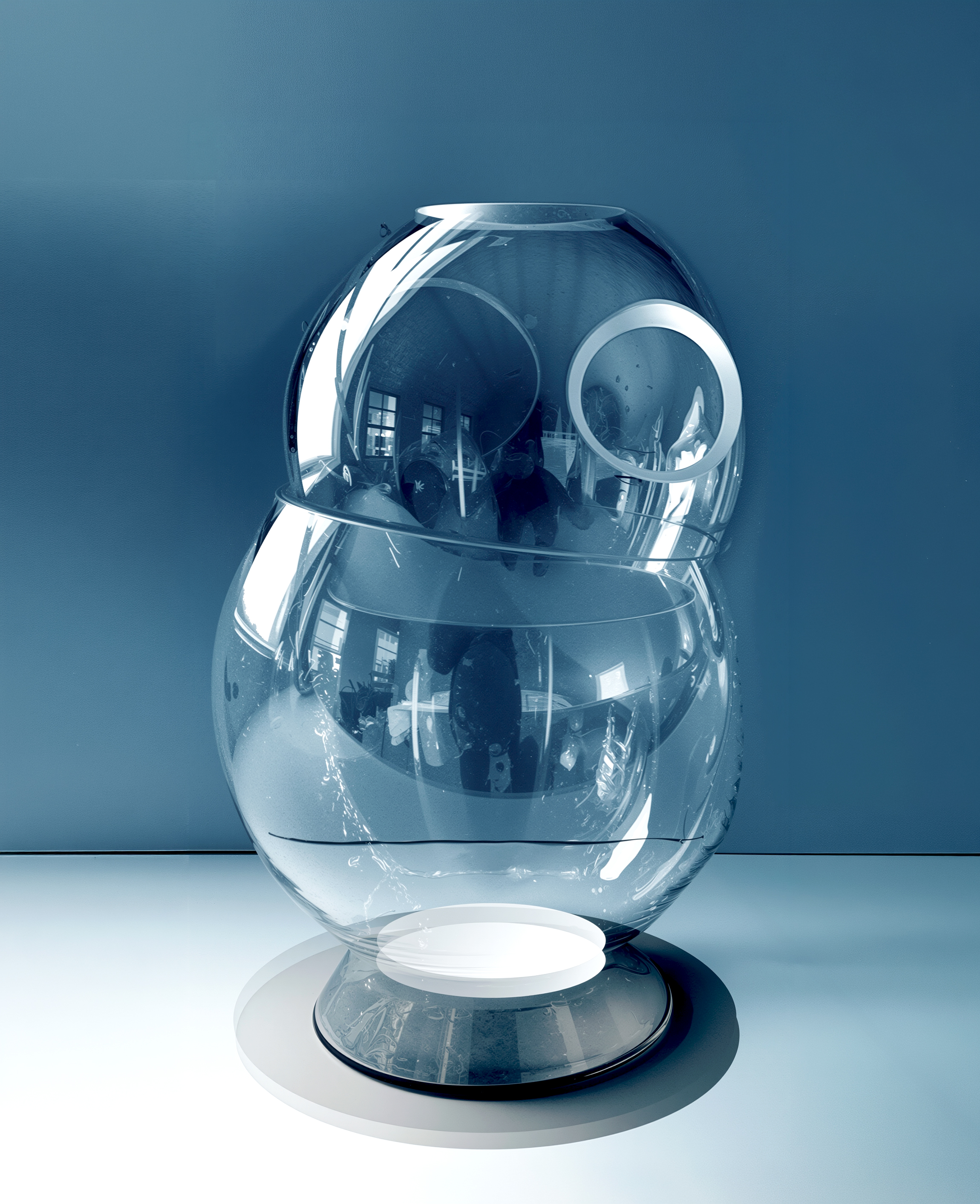
The service comprises a teapot, coffeepot, and creamer, vessels whose forms derive from Asymptote’s computational design methods but whose realization demanded the most traditional of metalworking skills. The surfaces are not arbitrary: they are the product of digital simulations in which fluid geometries are generated, tested, and refined until each curve resolves simultaneously as a holdable volume, a pourable spout, and a sculptural object. The resulting forms appear to have been caught mid-flow, as if molten silver had been frozen at the instant of cascading over an invisible armature, yet they are precise, resolved, and structurally sound. The tray on which the vessels sit extends this logic into a flat plane that is not flat at all: its surface folds and facets like a topographic field, establishing a miniature landscape for the objects it supports.
Craft
Sterling silver is among the most demanding materials in which to realize complex freeform surfaces. Unlike stainless steel, which can be pressed and stamped at industrial scale, silver at this level of finish is raised, planished, and polished entirely by hand, a process that leaves no room for approximation. Each vessel in the set required hundreds of hours of work by Sawaya & Moroni’s specialist silversmiths, translating Asymptote’s digital models into physical form through a dialogue between computational precision and embodied craft knowledge accumulated over generations. The mirror-polished finish amplifies every subtlety of the surface: each curve, each inflection, each transition from concavity to convexity is legible in the reflections that move across the silver as the viewer shifts position.
Context
The service was presented at Milan Design Week in April 2007, when Sawaya & Moroni opened their showroom on Via Manzoni with three new additions to the Silver collection: Hani Rashid’s tea and coffee set, a suite of goblets and carafe by Massimiliano Fuksas and Doriana Mandrelli, and a silver bowl by Zaha Hadid. The company itself stands as one of the most significant patrons of architect-designed furniture and objects in contemporary Italian design, its roster of collaborators reads as a survey of late-twentieth and early-twenty-first-century architecture, from Hadid and Libeskind to Ron Arad, Santiago Calatrava, and Jean Nouvel. Within this lineage, the tea and coffee service represents Asymptote’s contribution to a tradition that extends back to the great silversmith-architects of the Baroque, the proposition that the intelligence required to shape a building is the same intelligence required to shape the vessel from which one drinks.