Interiors · 2000 · Realized
Renault, Geneva Motor Show Installation
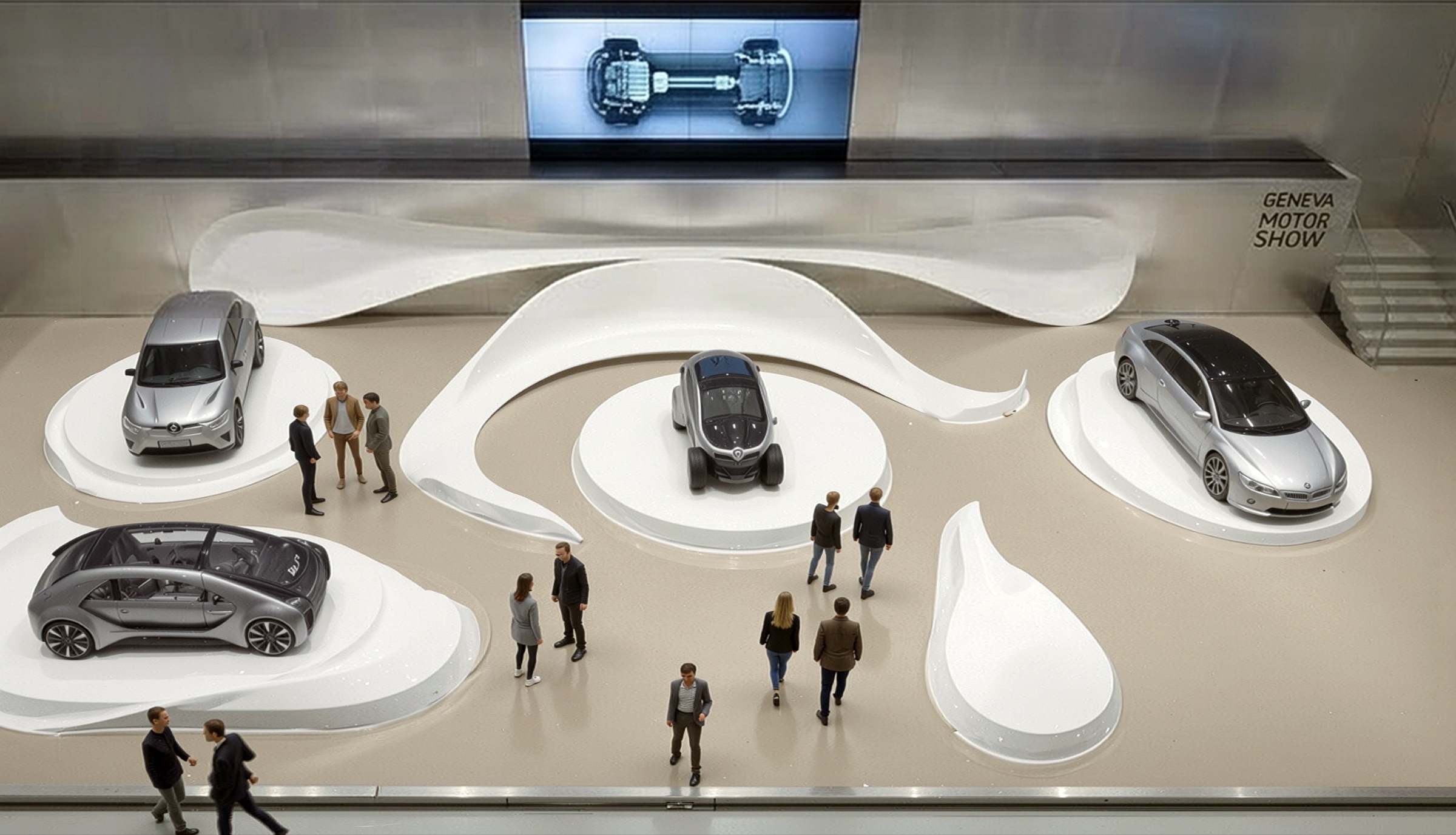
An exhibition installation for Renault at the Geneva International Motor Show, a sinuous white sculptural landscape that dissolves the conventional boundaries between display plinth, circulation path, and branding surface, presenting the automaker's concept fleet as a single topographic composition within the Palexpo hall.
About the project
Landscape Rather Than Stand
The conventional motor show stand treats each vehicle as an isolated object on its own turntable or plinth, separated from its neighbors by aisles and connected only by signage and brand graphics. The Renault installation at the Geneva International Motor Show proposed a fundamentally different spatial model. A continuous white sculptural surface, part ground, part furniture, part topography, flows across the full extent of the stand, rising and falling to form individual display platforms for each vehicle before descending again to become the floor on which visitors walk. The result is that the cars, the circulation, and the architecture read as a single unified composition rather than an assembly of discrete elements.
Topographic Surface
The central design element is a sinuous, doubly curved surface fabricated in white composite that weaves between the vehicles like a frozen wave. At its peaks, it lifts to form elevated plinths for the flagship concept cars, placing them at eye level and giving them a sense of ceremonial arrival. Between peaks, it dips to create valleys and channels that naturally guide visitor movement without the need for barriers, ropes, or directional signage. The edge condition is equally deliberate: where the sculptural surface meets the exhibition hall floor, it does so through a series of smooth, elliptical transitions, soft landings that invite visitors to step onto the surface and move among the vehicles rather than viewing them from a fixed perimeter.
Fleet as Composition
By embedding every vehicle within a single topographic field, the installation reframes Renault’s lineup as a coherent design family rather than a collection of independent models. Compact city cars, electric concepts, and flagship sedans coexist on the same surface, their relationships made legible through proximity, elevation, and the directional flow of the landscape itself. The hierarchy is spatial rather than graphic: the most important concept vehicles occupy the highest elevations and the most generous clearances, while production models cluster at lower plateaux closer to the visitor flow. From the upper gallery, the entire stand reads as an aerial landscape, a white terrain populated by silver objects, each finding its natural position within the composition.
Media and Branding
Large-format media screens are suspended at key points above the landscape, displaying vehicle animations, technical diagrams, and brand films. Their placement is calibrated to the sightlines generated by the topographic surface: each screen is positioned where a natural pause in the visitor’s movement occurs, at a valley between two vehicle platforms, or at the stand’s outer edge where the full panorama comes into view. The brushed metal rear wall carries the GENEVA INTERNATIONAL MOTOR SHOW identity alongside Renault branding, its reflective surface doubling the depth of the stand and catching the white glow of the sculptural surface below. Brand identity is conveyed through the architecture itself, the fluid, technically sophisticated surface language, rather than through applied graphics.
Atmosphere and Light
The stand’s all-white material palette and smooth, continuous geometry create an environment that is simultaneously clinical and sensual. Overhead, linear ceiling fixtures provide even, shadow-free illumination that reinforces the purity of the white surface and allows the metallic finishes of the vehicles to read with maximum clarity. The absence of color in the architecture means that every chromatic event belongs to the cars themselves, their silver, grey, and dark finishes become the only tonal variations in the visual field. The effect is closer to a gallery installation than a trade-show exhibit: a controlled atmosphere where attention is focused entirely on the objects and the spatial experience of moving among them.