Cultural · 1989 · Competition
Alexandria Library
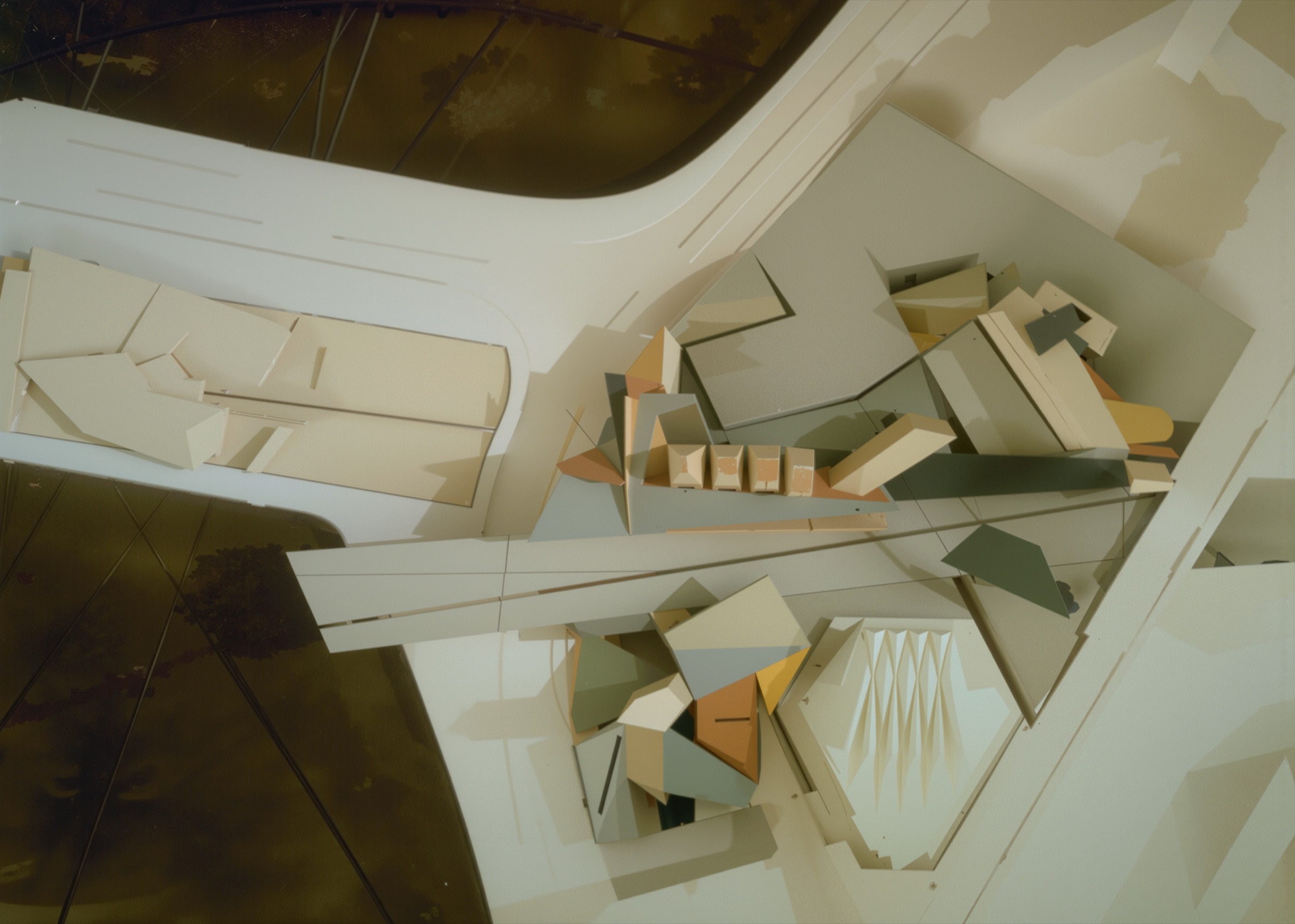
Runner-up in the landmark 1989 international competition for the revival of the ancient Library of Alexandria, one of the largest architectural competitions of the twentieth century, attracting 524 entries from 52 countries. Snøhetta's winning design was completed in 2002.
About the project
The international competition for the Bibliotheca Alexandrina was among the most significant architectural events of the late twentieth century. Organized in 1988 by the Egyptian government in collaboration with the International Union of Architects (UIA) and UNESCO, it called for the design of a new national library on the Mediterranean seafront of Alexandria, near the site of the ancient library, one of the most storied institutions in human history. Over 1,300 architects from 77 countries registered, and 524 entries were submitted to a jury of seven architects and two librarians.
The Entry
Asymptote’s proposal was awarded runner-up, placing the young practice, then only recently established in New York, at the forefront of international architectural discourse alongside the winning entry by the Norwegian firm Snøhetta. The competition came at a formative moment for the studio, contemporaneous with the Steel Cloud competition win in Los Angeles, and confirmed that the radical spatial investigations Rashid and Couture were pursuing had resonance at the highest levels of institutional ambition.
Context
The brief asked for far more than a library. The new Bibliotheca Alexandrina was to be a cultural complex of national and international significance, a center for research, learning, and cross-cultural exchange that could stand as a modern counterpart to the ancient institution founded in the third century BCE. The site, between Alexandria University and the Corniche waterfront, demanded a design that could hold its own against the scale of the Mediterranean and the weight of historical memory.
Legacy
Snøhetta’s winning design was completed in 2002 and received the Aga Khan Award for Architecture in 2004. The Bibliotheca Alexandrina competition remains a landmark moment in contemporary architecture, a rare instance where the international community was asked to collectively reimagine one of civilization’s foundational institutions. Asymptote’s runner-up placement, alongside the Steel Cloud first prize, established the studio’s early reputation as a practice capable of operating at the scale of cultural and civic ambition.