Cultural · 2001 · Competition
Eyebeam Center for Electronic Arts
A competition entry for a new center for electronic arts in Chelsea, New York, featuring a striking glass-clad tower and expansive interior spaces designed to merge art, technology, and public engagement.
About the project
In 2004, the Eyebeam organization, then operating out of a converted warehouse on West 21st Street, launched an invited competition for a purpose-built facility in Chelsea that could house its expanding program of artist residencies, exhibitions, and digital production labs. Asymptote’s entry presents a sculptural glass-clad tower that rises from the streetscape with a faceted, angular facade, its translucent skin catching and reflecting the surrounding urban context. The building’s exterior form breaks away from the traditional rectilinear block, instead folding and tapering upward to create a distinctive silhouette that signals the innovative program within.
Interior Landscape
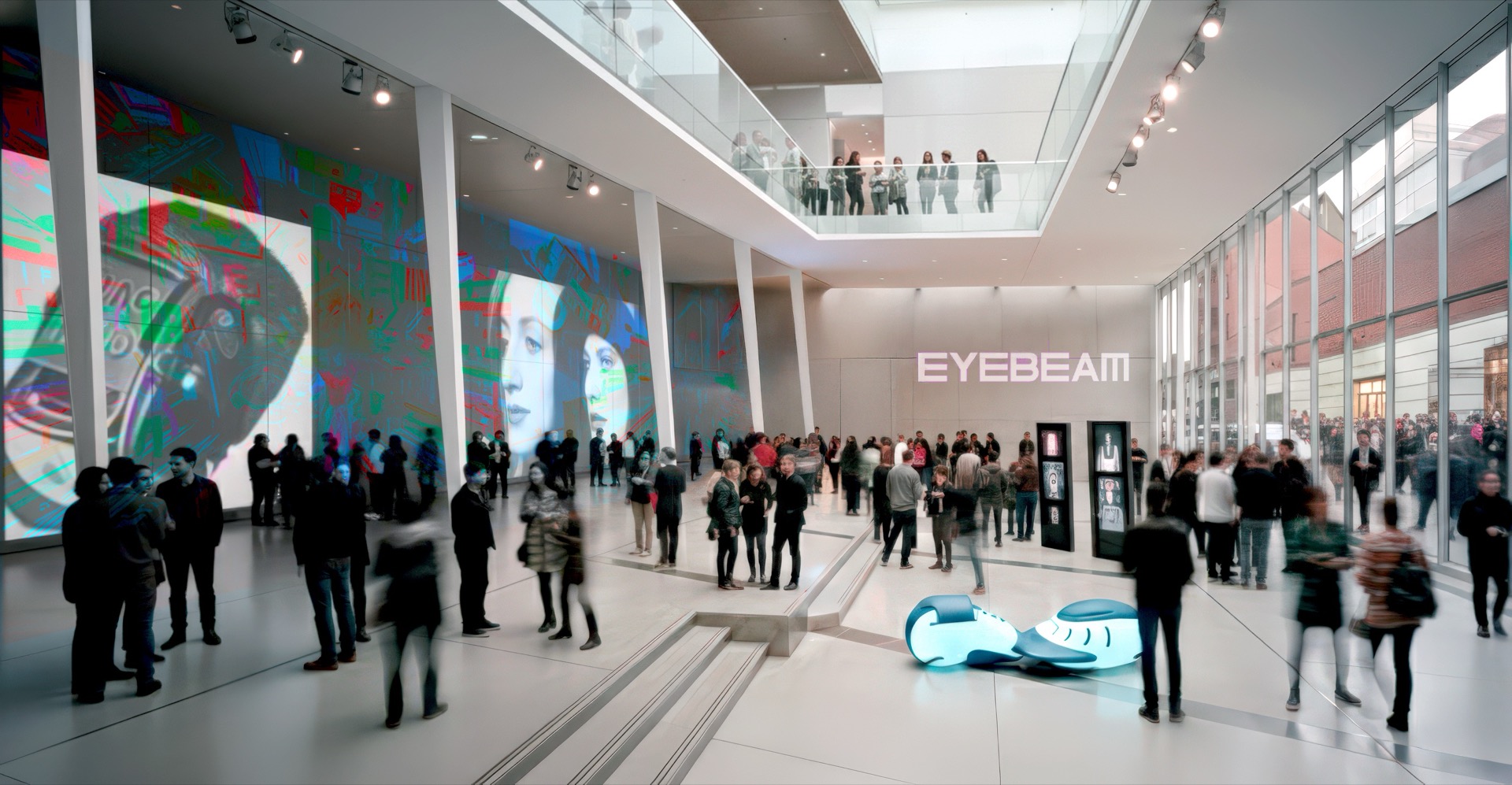
The interior spaces are conceived as a continuous landscape of exhibition, production, and gathering. A generous ground-floor lobby doubles as a large-scale gallery, with soaring ceilings, full-height digital projection walls, and an open plan that invites the public into the world of electronic art. The centerpiece of the building’s interior is a multi-level atrium anchored by a sweeping wooden amphitheater staircase, which serves as both circulation and informal seating for performances and events. A curved digital media wall wraps around this central void, embedding technology directly into the architecture.
Exhibition Halls
At the upper levels, vast industrial-scale exhibition halls feature exposed steel cross-bracing and raw concrete surfaces, providing a dramatic backdrop for large-format projected artworks and immersive installations. Ramped walkways along the perimeter allow visitors to experience the art from shifting vantage points, reinforcing the building’s ambition to dissolve boundaries between viewer and artwork, structure and screen. The project embodies Asymptote’s vision of architecture as a dynamic interface between physical space and digital culture.