Villas · 2017 · Commission
Wing House
A private villa in Noormarkku, Finland whose sculptural white shell, derived from the M-Scape landscape studies, fuses architecture and topography into a continuous inhabited surface set among birch forests on the historic Gullichsen estate.
About the project
From M-Scape to Dwelling
The Wing House originates in the M-Scape series, a body of sculptural and digital landscape studies first exhibited at de Pury & Luxembourg and later acquired by the Museum of Modern Art for its permanent collection. Those works explored the idea of an architecture that is indistinguishable from its ground: a continuous surface that folds, lifts, and hollows to create inhabitable space without recourse to conventional walls, floors, or roofs. The Wing House translates that proposition from gallery to site, from speculation to domestic program, producing a residence where the boundary between building and landscape is genuinely dissolved.
Site and Legacy
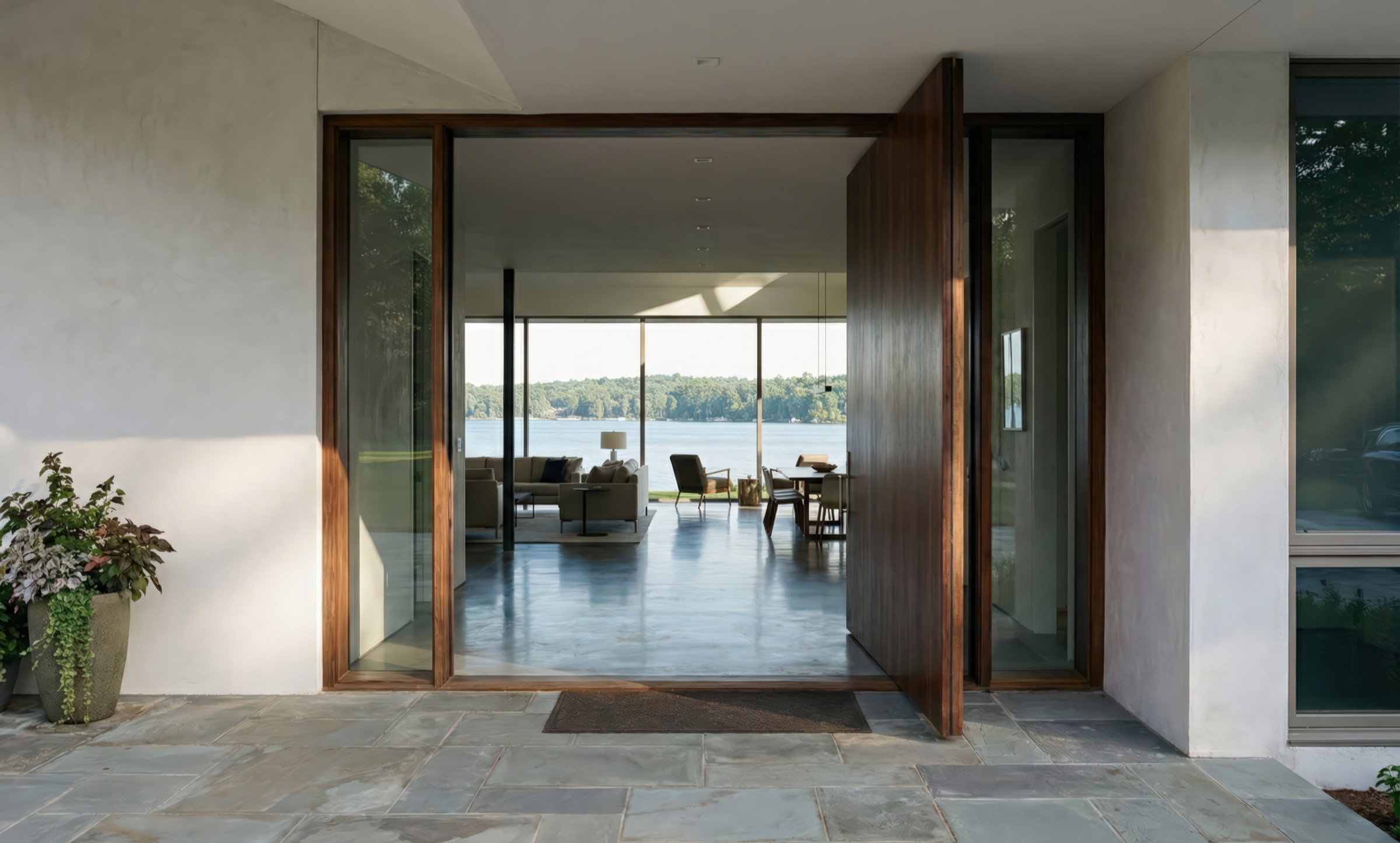
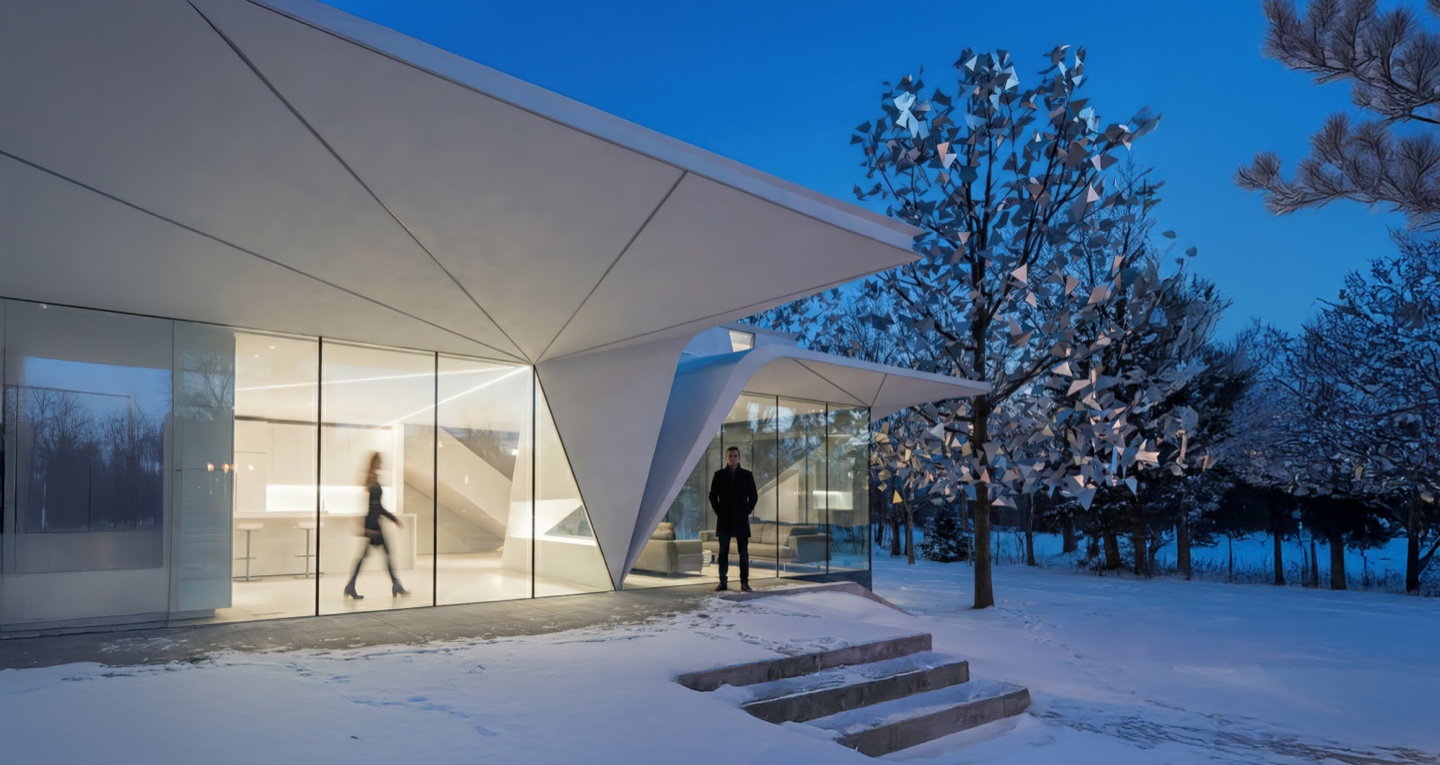
The house is sited on the Gullichsen estate in Noormarkku, Finland, the same ground on which Maire and Harry Gullichsen commissioned Villa Mairea from Alvar Aalto in 1939, a foundational site of Finnish modernism. The commission places Asymptote’s work in direct dialogue with that legacy: the fluid, organic geometries of the Wing House acknowledge the humanist warmth of Aalto’s architecture while operating with an entirely different formal and material vocabulary. The house is set within a dense birch forest, and the design responds to the extreme seasonal shifts of the Finnish climate, from deep winter snowscapes to golden summer fields, by framing the landscape through precisely shaped apertures that function as composed pictures of the changing world outside.
Sculptural Shell
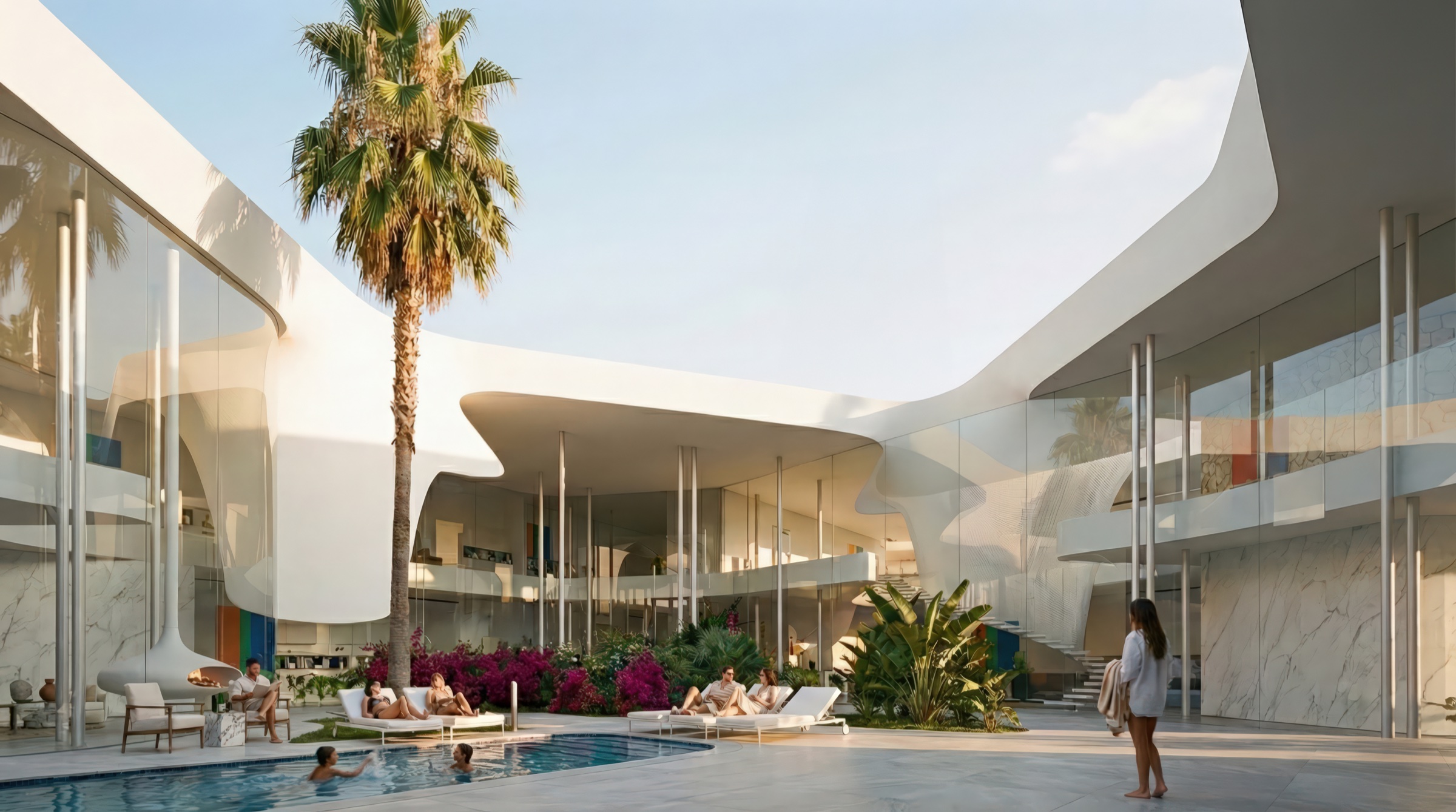
The building reads as a single continuous white shell that rises from the terrain, branches into wing-like volumes, and returns to the ground. There are no conventional elevations; the exterior is a smooth, monolithic surface punctuated by organic openings, oval windows, elongated slots, and oculus skylights, that admit light and frame views with the precision of a camera. The shell is load-bearing concrete finished in a seamless white skin, giving the house an almost geological presence among the birch trunks, as though it had been deposited on the site rather than constructed.
Interior Landscape
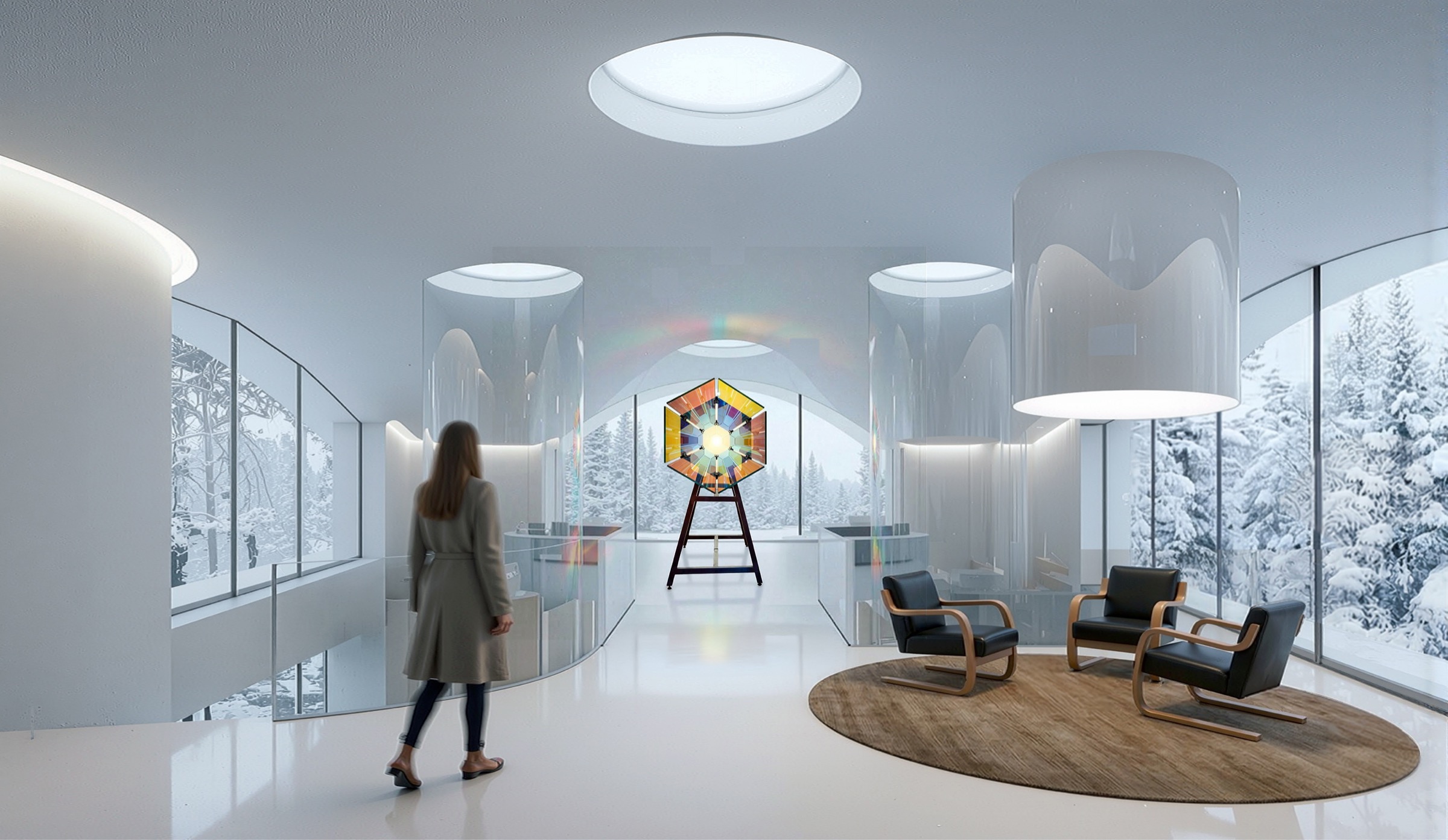
Inside, the spatial logic of the M-Scapes persists. Rooms are not enclosed boxes but zones defined by the curvature of the continuous shell: a sunken living area with fireplace is separated from the gallery hall by curving glass partitions; sleeping pods are moulded directly into the wall thickness as sculpted alcoves; a vaulted garage pavilion with an oculus skylight doubles as an arrival threshold. The interior palette is restrained, white concrete, dark stone floors, timber treads, tan leather, and marble, allowing the architecture itself and the framed landscape to dominate the experience.
Vertical Circulation as Sculpture
Two staircases organize movement between the wings. The principal stair is a helical timber-treaded spiral set within a smooth cylindrical void, framed by a full-height oval window that draws the landscape upward through the section. A secondary white spiral drops through an open well connecting upper and lower levels, visible from above as a pure sculptural form. Both stairs function less as connectors between floors than as spatial events, moments where the inhabitant moves through the shell’s thickness and experiences the house as a three-dimensional landscape.
Light and Aperture
Every opening in the shell is designed as both a light instrument and a landscape frame. The large oval windows in the bedrooms and living spaces bring the birch forest to eye level; cylindrical skylights in the gallery admit zenithal light that washes down the curved white walls; a panoramic curved window in the reading alcove shifts its character entirely between seasons, presenting winter snowfield and summer grain field through the same carefully proportioned aperture. The house is, in this sense, a device for looking, an architecture that privileges the act of seeing the world from within.
MoMA and the M-Scape Lineage
The Wing House belongs to a larger body of work that traces the translation of digital landscape research into physical form. The original M-Scape drawings and models, exhibited at de Pury & Luxembourg, at the Venice Biennale’s Arsenale, and in the I-Scape and Flux 3.0 installations, established the formal vocabulary of continuous folded surfaces, organic apertures, and dissolved ground planes that the Wing House inhabits at the scale of a dwelling.
Venice Biennale
The Wing House was presented at the 11th Venice Architecture Biennale in 2008 as part of Prototyping The Future: Three Houses for the Subconscious, curated by Aaron Betsky for the exhibition “Out There: Architecture Beyond Building.” The installation in the Corderie dell’Arsenale featured three large fiberglass M-Scape sculptures behind mirrored glass panels, the Wing House among the “three houses” explored as prototypes for subconscious dwelling. Five documentation photographs by Christian Richters are held in MoMA’s collection.
Museum Collection
The Wing House is represented by 22 works in the permanent collection of the Museum of Modern Art (MoMA), New York, in the Department of Architecture and Design, the most extensive holding of any single Asymptote project. The collection includes two architectural models (a paper, cardboard, acrylic, and polystyrene model and the polystyrene, wood, and paint model), four digital renderings, three plan drawings, two section drawings, an exploded axonometric, a perspective drawing, the Flux 3.0 M-Scape video (color, silent, 2 min 15 sec), and photographs by Christian Richters documenting the 2008 Venice Biennale installation. All Wing House works were acquired through the Committee on Architecture and Design Funds.
The models and video were featured in MoMA’s Endless House: Intersections of Art and Architecture exhibition (June 2015 – March 2016), which explored the long history of architects and artists envisioning dwellings as continuous, organic forms.