Exhibitions · 2008 · Realized
Prototyping The Future: Three Houses for the Subconscious
Three large fiberglass sculptural objects presented at the Arsenale for the 11th Venice Architecture Biennale, conceived digitally and inspired by fluid dynamics, ballistics, and mathematical modeling, exploring what buildings might look like if subjected to wind tunnel testing.
About the project
Prototyping The Future: Three Houses for the Subconscious was presented at the Corderie dell’Arsenale as part of the 11th International Architecture Exhibition at the Venice Biennale in 2008. The exhibition, titled “Out There: Architecture Beyond Building,” was curated by Aaron Betsky, who invited architects to move beyond conventional building and explore architecture as a spatial and experiential art. Asymptote’s installation was one of the centerpiece works in the Arsenale’s historic rope factory.
The Installation
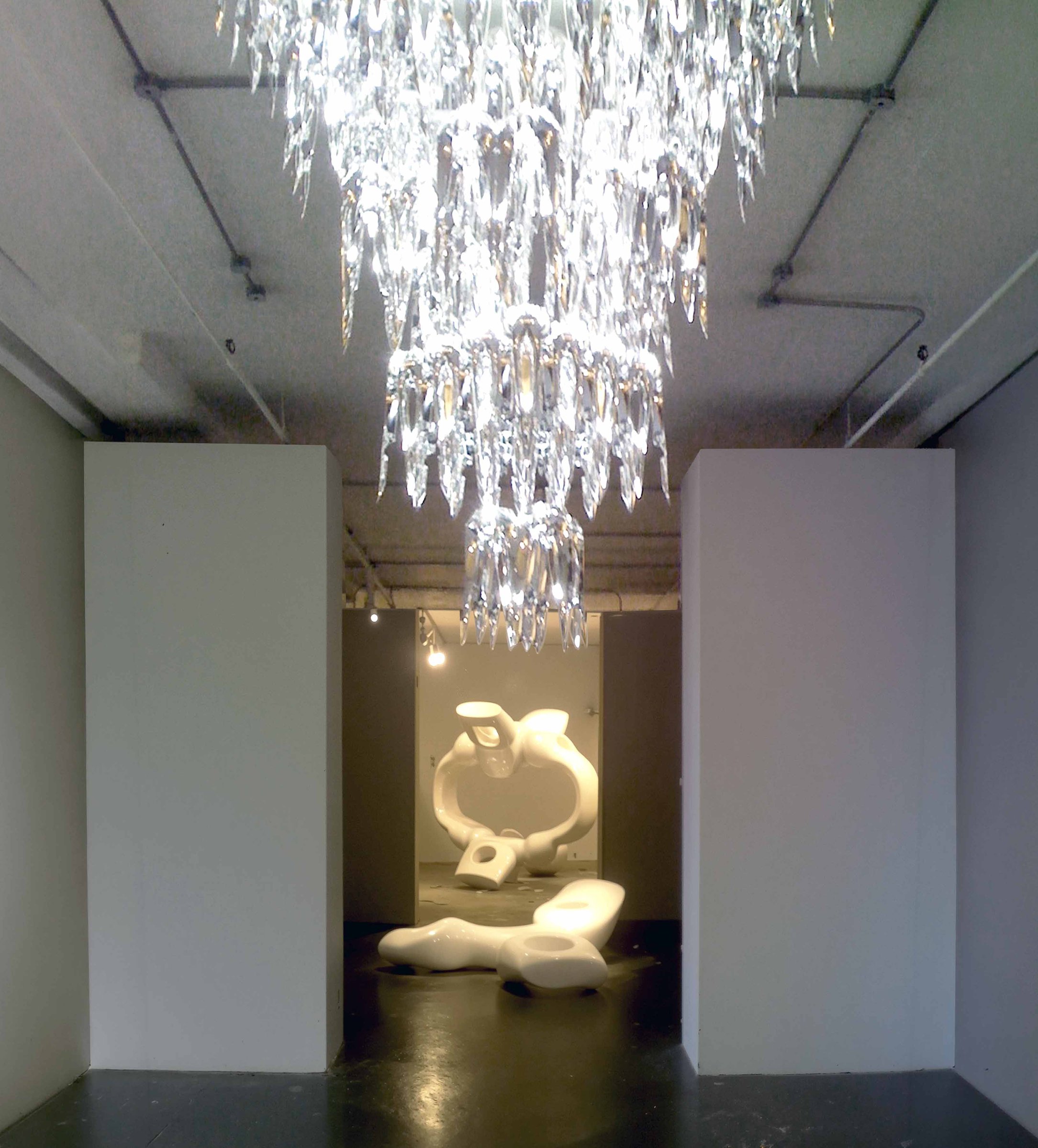
Three large vertebra-like sculptural objects in fiberglass occupied a bay of the Corderie, each measuring 13.5 by 3.5 by 3.6 meters. Conceived digitally and inspired by fluid dynamics, ballistics, and mathematical modeling, the smooth-skinned forms were separated by large panels of one-sided reflective mirrored glass, creating optical flux and interference of perception that multiplied the objects into an infinite visual field. Lit from within by Zumtobel lighting, the sculptures glowed against the Arsenale’s 16th-century brick vaults.
Between Furniture and Buildings
The three houses were situated deliberately between the scale of furniture and that of large-scale buildings, too large to be objects, too fluid to be architecture. Betsky’s curatorial thesis called for works that challenged the boundaries of what architecture could be, and Asymptote’s response proposed a wind tunnel of architectural possibilities: forms shaped as if buildings had been subjected to the aerodynamic testing of cars and planes. The vertebra-like profiles and biomorphic curves extended the practice’s ongoing investigation into motionscapes, formal experiments exploring flux, technology, and organicism.
Museum Collections
Five documentation photographs of the installation by Christian Richters are held in the permanent collection of the Museum of Modern Art (MoMA), New York, in the Department of Architecture and Design, acquired through the Committee on Architecture and Design Funds. The photographs document the Wing House M-Scape sculptures in the Corderie dell’Arsenale under various lighting conditions.
Fabrication was executed in fiberglass by Seal, Inc., with glass by Tamglass.