Exhibitions · 2002 · Realized
Moving Pictures
Exhibition design, catalog design, and brand identity for the Solomon R. Guggenheim Museum's Moving Pictures, a landmark survey of contemporary photography, film, and video by over fifty artists, filling the entire Frank Lloyd Wright rotunda and two adjacent galleries.
About the project
Moving Pictures was a major exhibition at the Solomon R. Guggenheim Museum in New York, on view from June 28, 2002 through January 12, 2003, with exhibition design by Hani Rashid and Lise Anne Couture of Asymptote. The show proposed that the extensive use of reproducible mediums in contemporary art, photography, film, and video, has its roots in the radical artistic practices of the late 1960s and 1970s, when these technologies were first absorbed into critical art practices to record performative events and render visible new conceptual systems.
Exhibition Design
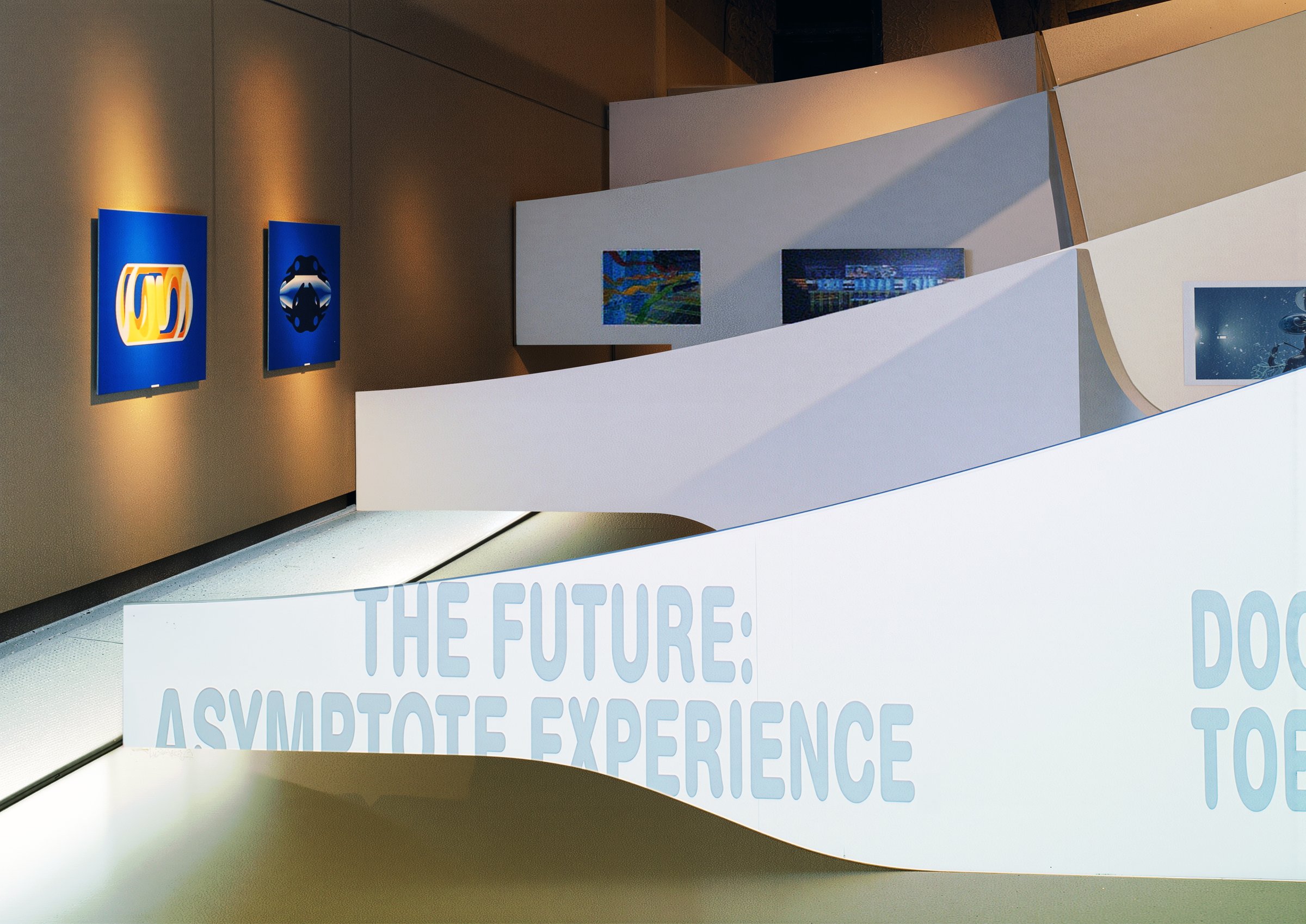
The installation filled the museum’s entire Frank Lloyd Wright–designed rotunda and two adjacent galleries, organizing a complex curatorial narrative across the spiraling ramps. The design addressed the challenge of presenting photography, film, video projection, and large-scale installation within one of architecture’s most iconic and spatially demanding interiors, a continuous helical gallery where every work exists in visual dialogue with every other.
Rotunda Sequence
The exhibition followed a loose chronological order ascending the rotunda. The ground level opened with works using reproducible mediums in unexpected ways, including Kara Walker’s black paper silhouettes with projected color layers and Felix Gonzalez-Torres’s photographic billboard. The next level was devoted to seminal 1970s artists, Marina Abramovic, Vito Acconci, Ana Mendieta, Bruce Nauman, and Robert Smithson, whose performative work deeply influenced the generation that followed. Higher levels presented the Becher school of German photography, the constructed image, and culminated with large-scale projection and multimonitor installations by Stan Douglas, Pierre Huyghe, William Kentridge, Steve McQueen, Shirin Neshat, and others.
Acoustic Design
On the upper ramps, tall inclined walls clad with blue pyramid foam transformed the bay galleries into intimate cave-like viewing chambers, providing both a visually striking intervention within the Wright interior and the acoustic isolation essential for presenting film and video projection works. The material choice addressed the rotunda’s notorious sound bleed, allowing works by Stan Douglas, Shirin Neshat, Steve McQueen, and others to be experienced with proper audio separation for the first time in the spiral.
Catalog and Brand Identity
Asymptote also designed the exhibition catalog, Moving Pictures: Contemporary Photography and Video from the Guggenheim Collection, published by Guggenheim Museum Publications and co-published by Thames & Hudson (2003, 228 pages). The studio developed the brand identity for the exhibition, establishing a graphic language that carried across all printed and environmental materials.
Featured Artists
The exhibition drew from the Guggenheim’s permanent collection and included over fifty artists spanning three decades, among them Matthew Barney, Sophie Calle, Gregory Crewdson, Olafur Eliasson, Andreas Gursky, Candida Höfer, Roni Horn, Gabriel Orozco, Cindy Sherman, Hiroshi Sugimoto, Thomas Struth, Sam Taylor-Wood, and Wolfgang Tillmans, representing the full breadth of contemporary lens-based and time-based art practice.
The exhibition subsequently traveled to the Guggenheim Museum Bilbao (October 2003 – May 2004), where Asymptote designed a separate installation adapted to Frank Gehry’s galleries.