Museums · 2002 · Competition
Mercedes-Benz Museum
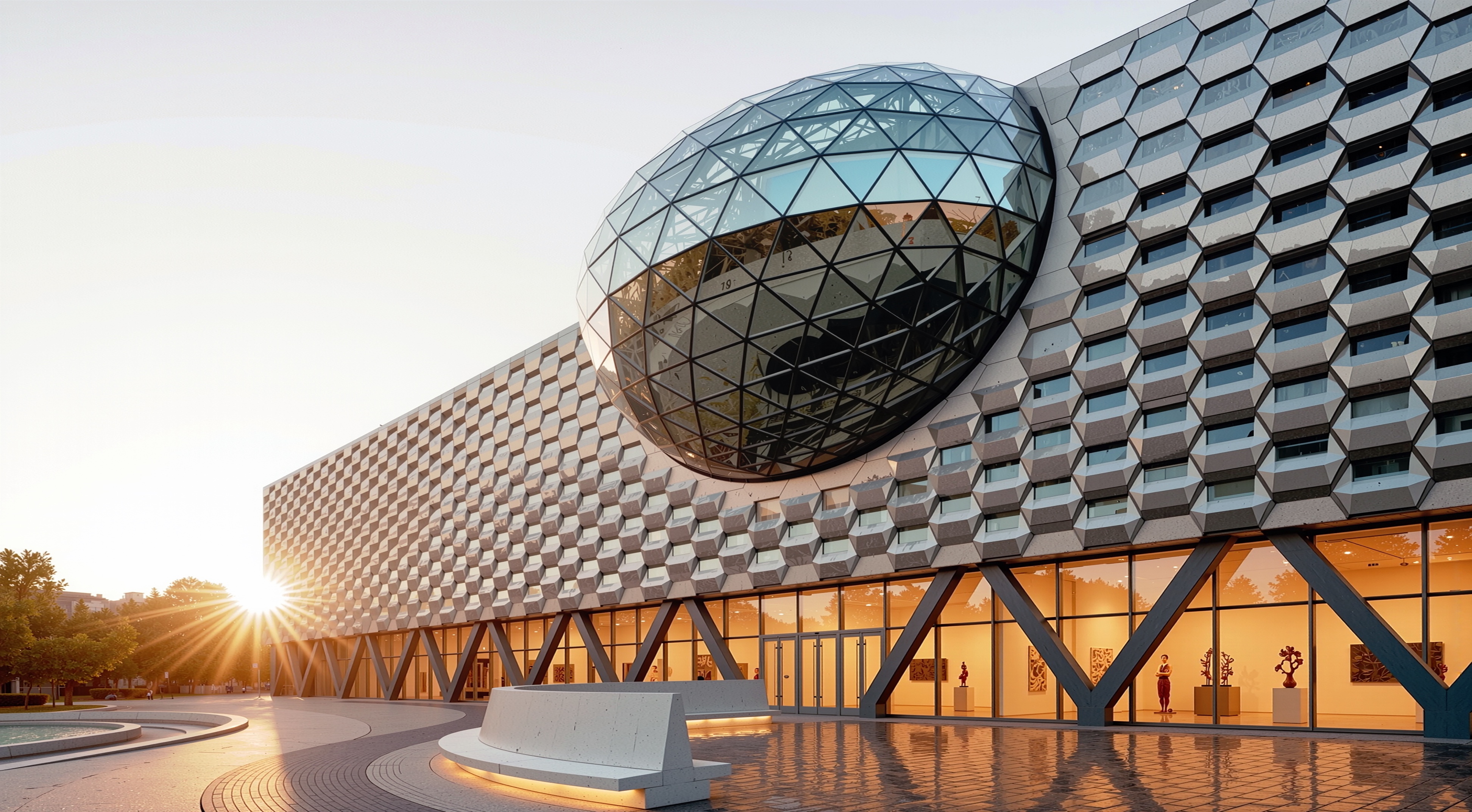
An invited international competition entry for the Mercedes-Benz brand heritage museum on a site at Stuttgart-Untertürkheim, adjacent to the Mercedes-Benz factory and the Gottlieb-Daimler-Stadion. The proposal organises the collection within a continuous topographic interior landscape contained beneath a fluid metallic envelope, with vertical glazed showcase lanterns drawing daylight into the exhibition halls.
About the project
Asymptote’s entry for the invited international competition for the new Mercedes-Benz Museum was developed for a site at Stuttgart-Untertürkheim, adjacent to the Mercedes-Benz Untertürkheim plant and the Gottlieb-Daimler-Stadion, on the Neckar. The brief, issued by DaimlerChrysler in 2001 and decided in January 2002, called for a heritage centre to consolidate the marque’s collection of historic vehicles within a single architectural and curatorial setting. The competition was won by UN Studio; the ten invited firms also included SANAA, Angélil Graham Pfenninger Scholl, Lederer Ragnarsdóttir Oei, Alberto Campo Baeza, Kollhoff & Timmermann, and Schneider + Schumacher.
Envelope and Site
The proposal is contained within a continuous, fluidly modelled aluminium envelope whose surfaces curve and fold to admit large window apertures at points of public address. The form mediates between the industrial scale of the adjacent factory and the open ground of the stadium plaza, presenting a vehicular silhouette to the approach roads and a quieter elevation toward the Neckar.
Interior Landscape
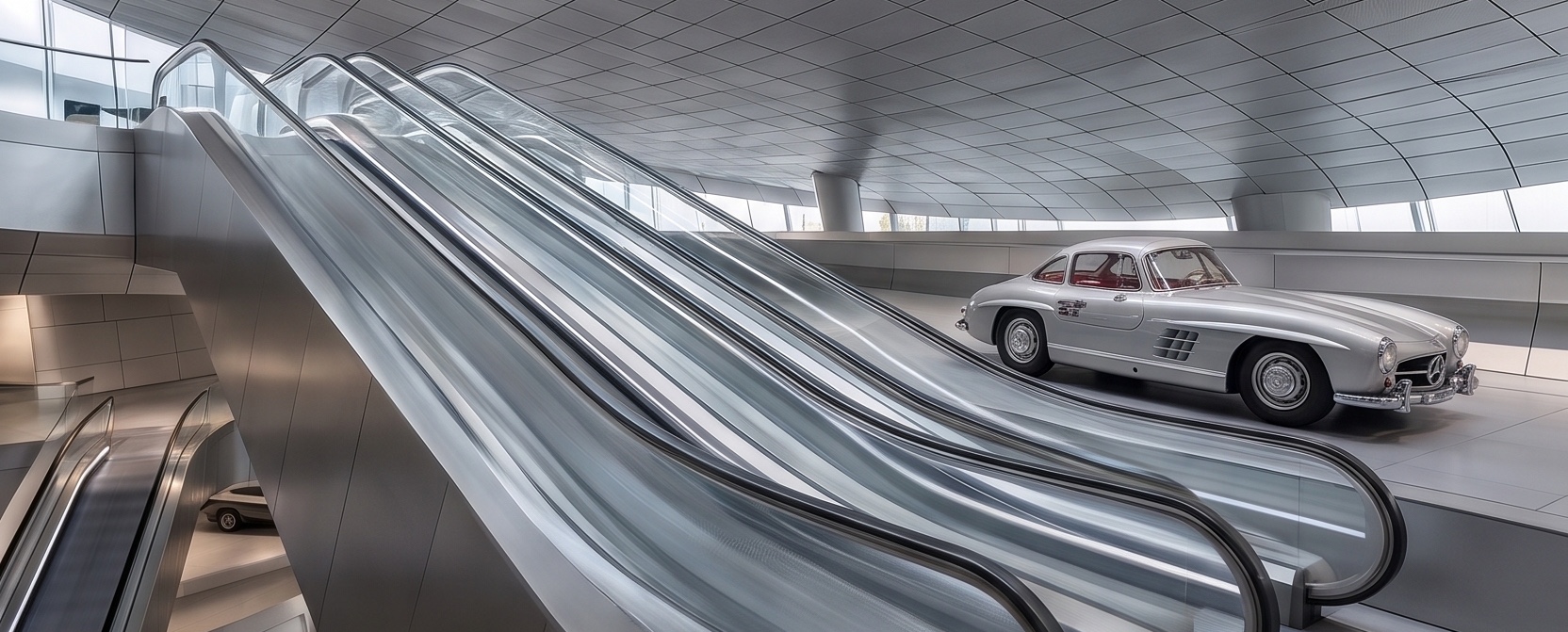
The exhibition floor is conceived as a sculpted topography, terraced display platforms, ramped circulation, and lower pooled platforms carved into a single continuous white surface, through which the historic vehicles are arranged as a navigable archive rather than a linear chronology. Vertical glazed lanterns, structured as diagrid cages, draw daylight down into the halls and provide visual links between levels. Oval and elliptical roof oculi punctuate the ceiling plane, calibrating natural light across the depth of the floor plate while preserving the controlled environment required for the collection.