Virtual Environments · 1997 · Realized
NYSE Three Dimensional Trading Floor
The world's first large-scale virtual reality environment conceived as a digital twin of the New York Stock Exchange trading floor, a fully navigable real-time data landscape built on Silicon Graphics Reality Engine hardware that transformed raw market information into architectural space.
About the project
In 1997 the New York Stock Exchange commissioned Asymptote, working in collaboration with the Securities Industry Automation Corporation (SIAC), to design a virtual reality environment that would visualize the full breadth of real-time trading activity on the exchange floor. What emerged was the Three Dimensional Trading Floor, the 3DTF, arguably the world’s first large-scale architectural digital twin and one of the earliest immersive data visualization environments ever built for operational use.
A Virtual Architecture of Information
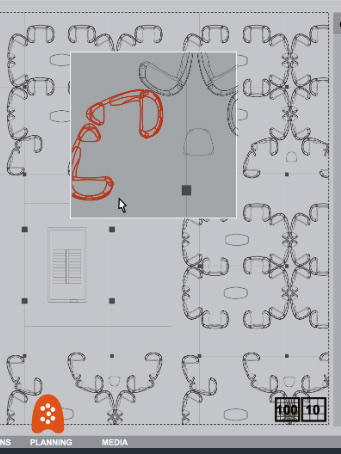
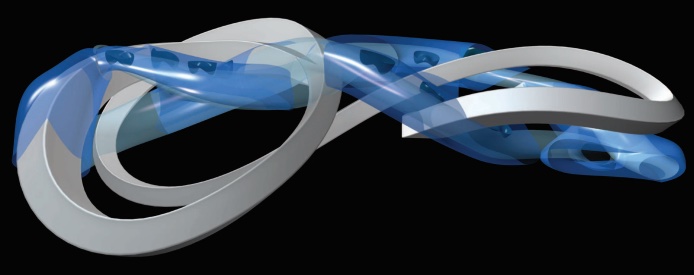
Rather than display market data in conventional flat charts and tables, Asymptote reconceived the entire trading floor as a navigable three-dimensional landscape. Every stock, every index, every trade, and every news event was mapped spatially, transforming raw numerical data into an architectural experience. Trading posts became luminous cylindrical volumes whose heights and colors shifted with activity. Stock tickers flowed as ribbons through space. Volume data rose and fell as topographic surfaces. Live television feeds from the physical floor and financial news broadcasts were composited directly into the virtual environment, creating a dense, layered information field that could be traversed, zoomed, and interrogated in real time.
The design drew on Asymptote’s long-standing interest in the relationship between physical and virtual space, treating data not as abstract graphics but as spatial material, something to be inhabited rather than merely read.
Silicon Graphics and the State of the Art
The 3DTF was built using the most powerful real-time rendering hardware available at the time: Silicon Graphics Onyx workstations equipped with RealityEngine graphics processors. The environment was developed in Softimage and Alias and rendered using VRML (Virtual Reality Modeling Language) alongside custom software written to parse and spatialize the NYSE’s live data feeds. The system drove an array of nine high-resolution flat-screen displays installed in the exchange’s operations center, providing continuous real-time monitoring of market conditions across every listed security.
At a time when most data visualization remained two-dimensional, the 3DTF represented a radical proposition, that architecture itself could become an interface for understanding complex systems.
MarkeTrac and OrderTrac
The success of the 3DTF led to two subsequent projects: MarkeTrac and OrderTrac, developed between 2000 and 2001, which brought the virtual trading floor to the web. MarkeTrac allowed remote users to monitor real-time market data through the same spatial interface from a personal computer, while OrderTrac enabled online stock trading within the environment. Though other platforms were beginning to offer real-time data online, MarkeTrac was among the first to include a substantial data visualization component, extending Asymptote’s architectural thinking into the emerging landscape of internet-based finance.
September 11 and the Reopening of the Markets
The 3DTF assumed an unexpected and critical role following the September 11, 2001 attacks on New York. In the days after the towers fell, with lower Manhattan shut down and the exchange closed, the command center housing Asymptote’s virtual environment became the first operational space used to test whether the NYSE’s trading systems could be safely brought back online. Staff used the 3DTF to run simulations and systems checks, verifying that the exchange infrastructure was intact and capable of handling the volume that would follow reopening. The work performed in Asymptote’s environment helped assure that the markets reopened on September 17, 2001, a pivotal moment in the city’s recovery.
Legacy
The NYSE 3DTF anticipated by more than a decade the concepts now commonplace in data science and digital infrastructure: the digital twin, the immersive dashboard, the spatial interface. At the time of its launch in 1999, the project drew both acclaim and skepticism, some interface designers questioned whether a three-dimensional environment was truly more legible than conventional displays. But the 3DTF was used operationally by NYSE staff for years, and its significance as both a technological and architectural achievement has only grown. The complete project records, including Silicon Graphics image files, VRML environments, presentation materials, and press documentation, were acquired by the Canadian Centre for Architecture in Montreal as part of its Archaeology of the Digital research program, recognizing the 3DTF as a landmark in the history of computational design.
CCA Archive
The complete NYSE project records, approximately 50,600 digital files (73.2 GB), 71 drawings, 43 optical discs, and 32 folders of textual material, were acquired by the Canadian Centre for Architecture in Montreal. The archive documents the full arc of the project from 1991 to 2009, including Silicon Graphics databases, VRML environments, CAD files (Maya, Alias, Microstation, Form-Z), video demonstrations, presentation materials, correspondence, and press documentation. The collection encompasses the 3DTF, MarkeTrac, OrderTrac, and the Advanced Trading Floor Command Center.
Selected Writing
“Learning from the Virtual”, Hani Rashid, e-flux Architecture (Post-Internet Cities), 2017. Read on e-flux →